The presentation will be followed by discussions and refreshments, and is open to the everyone. Please register at events@roma.uio.no
Claire Dillon, PhD candidate at Columbia University and currently resident researcher at The American Academy in Rome:
Translating Textiles: Textual and Technical Analyses in the Study of Medieval Sicilian Silk
The historiography of medieval Sicilian silk has long been dominated by the Mantle of Roger II and the Norman royal regalia, overshadowing the many other textile fragments once attributed to the island. This paper offers a critical reassessment of this scholarly focus by tracing how such an imbalance emerged and continues to shape this field of inquiry. Through the examination of a silk textile interred with the Holy Roman Emperor Henry VI in Palermo, this study explores the potential of technical analysis to recover broader networks of production and exchange, both within the context of medieval Sicily and across wider Mediterranean silk routes.
Martin F. Lešák, postdoctoral fellow, The Norwegian Institute in Rome, University of Oslo:
Santa Susanna in Rome Across the Centuries: On the Image-Shaping Power of Liturgy
This paper examines how important 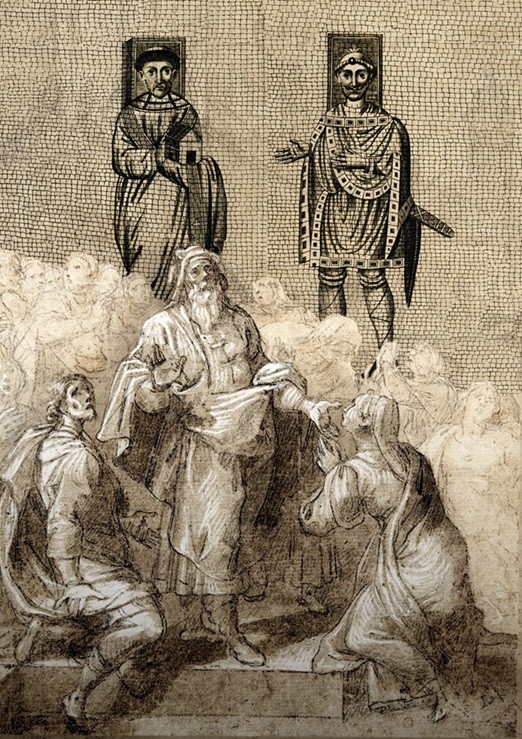 liturgical rituals may have shaped the conception of monumental decorations in the church of Santa Susanna in Rome across the centuries. Documented as a titular church since the fifth century, Santa Susanna was rebuilt under Pope Leo III around 800 and again under Cardinal Girolamo Rusticucci around 1600. While the early modern frescoes by Baldassare Croce, Paris Nogari, and Matteo Zaccolini remain visible today, the early medieval mosaic decoration survives only through late-sixteenth- and seventeenth-century descriptions and drawings. In both the early medieval and early modern phases, these monumental interior decorations were conceived for Roman liturgical life and function. This contribution will therefore analyze specific iconographic choices through the lens of the key liturgical rituals performed on the feast of St. Susan and during the papal stational liturgy on the third Saturday of Lent. Fundamental to this discussion is the primordial tension between artistic innovation and the rhythm of the liturgical annual cycle linked to the repetition of specific prayers, chants, and readings on specific liturgical days. By focusing on two key decorative – and indeed rebuilding – campaigns at Santa Susanna, this paper presents preliminary findings from a broader investigation into the image-shaping power of liturgy.