
Ending up on the radar of the Spanish Inquisition was no joke. Being a suspect was enough to make life difficult, not only for oneself, but also for one's nearest and dearest.
In her doctoral project, Ingrid S. Aakre Kibsgård (27), Ph.D. fellow in History at the University of Bergen, is looking for evidence that can shed light on such cases and how they were handled by the Curia. Since starting her project last autumn, she has been on two research stays in Rome, the first from October to November and the current one from May to early July.
An office for sin
– What are you doing in your Ph.D. project?
– I'm examining the archive of the Apostolic Penitentiary – a papal office at the Roman Curia where people could turn to obtain forgiveness for sins they had committed, or permission to do things that weren't really allowed, such as changing monasteries or even confessors. The archive has letters from people from all walks of life, but those I study are written by Spanish Christians in the 15th and 16th centuries who had got into trouble with the Inquisition.
The Penitentiary Archive holds several letters from individuals who have been convicted or suspected by the Inquisition, or who have had this happen to close family members, most often parents or grandparents. The supplicants ask the Curia for forgiveness, whether for something of which they themselves have been accused, or sins they have “inherited” from family members.
Ingrid is thus amongst the few who do indeed expect the Spanish Inquisition – if only in the source material.
– How often do you get Monty Python jokes?
– Often! Ingrid laughs. – Very often, even from students. It's what usually happens when I tell people about my project.
Division of labour or power struggle?
Although the penitentiary dates to the late 1100s, lack of sources from the first period means that the oldest registers are from the fourteenth century. This does not affect Ingrid's work, since the Spanish Inquisition was not founded until 1478.
– What do you hope to find out doing the project?
– The Spanish material concerning the Inquisition has never been mapped out on a large scale. I want to know more about how the penitentiary handled such letters; this has been done for other regions, including Scandinavia. And the connection between the Inquisition and the Curia is also very interesting.
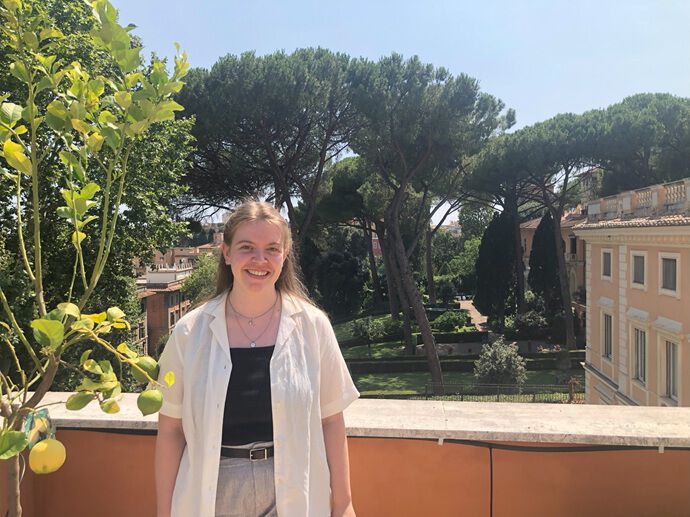
Ingrid says that the Inquisition was subjected to the Spanish monarch, and therefore not under the direct control of the penitentiary.
– There is still much we don't know about the relation between these institutions, but evidence suggests that there could often be a power struggle among them. For instance, there are several letters where the supplicant has been granted dispensation which also contain a message to the local bishop about making sure the dispensation is acted upon, and not sabotaged by the Inquisition.
- The project influences my sightseeing
Looking for material related to the Spanish Inquisition in an archive belonging to the papal Curia – it does give off Dan Brown associations. But according to Ingrid, the Penitentiary Archive is no dark or mysterious place, although she understands it might sound that way.
– When I went to the Vatican Archive last autumn, I envisioned deep basements and tall bookshelves, but it was actually a really open space.
The Penitentiary Archive belongs to the Vatican but is an independent archive. Although the archive is small, the material from Ingrid's period of study is fairly comprehensive. She therefore cannot exclude the possibility of having to return later for more archival research, something with which she has become quite familiar: Ingrid did her first research stay in Rome while still a master's student, aided by a scholarship from the Norwegian Institute.
The Institute has also served as a base for Ingrid during the current and previous stays. She appreciates having a workspace in the city besides the archive, and believes the stays in Rome have been crucial to her scholarly work, beyond the archive investigations themselves.
– The project has directed most of my sightseeing, because when I'm not working, I have tried to seek out churches mentioned in my material. Experiencing the place where the sources I work with originate has been very important in its own right.