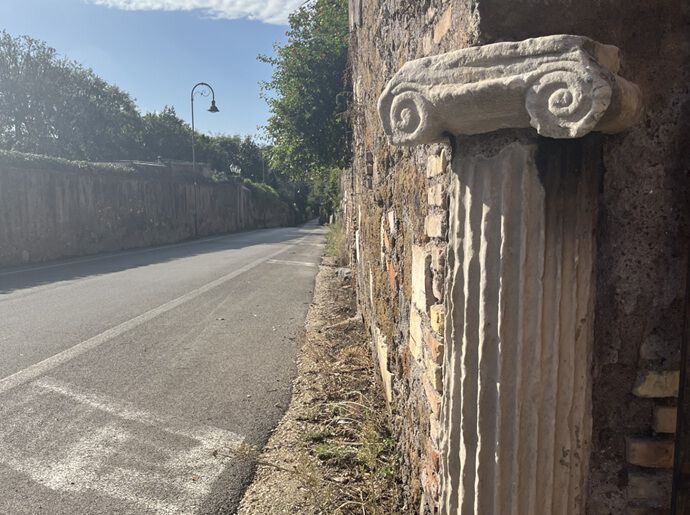
The project aims to conduct a comprehensive study of the development from antiquity to modern times of the area of the via Latina located within the Aurelianic Walls. The ancient via Latina extended for some 200 kilometres from Rome to Capua. Laid out by the mid-fourth century BC, it is one Rome’s oldest named roads, preceding its more famous, counterpart the via Appia, which also ran to Capua. While stretches of the via Latina and its monuments in the environs of Rome have been well-studied, the section inside of the third century AD Aurelianic walls is less well understood. Likewise, although the neighbouring, at times conjoining, zone of the via Appia within the Aurelian walls has received focused scholarly attention, comparatively, the parallel stretch of the via Latina has been neglected – a situation the project is intended to remedy.
The area being studied is a stretch of approximately 600 meters corresponding with today’s Via Porta Latina, from the Piazzale Numa Pompilio, where the road splits from the via Appia, to the Porta Latina in the Aurelianic walls. This area contains several important monuments of ancient, medieval, and early modern Rome, including Roman tombs and columbaria, the Basilica San Giovanni a Porta Latina, and the church of San Giovanni in Olio. Ancient texts record a number of other topographical features in this area the precise location of which is now unknown, and antiquarian sources and historic excavations also indicate a substantial amount of ancient sculptural and epigraphic material was discovered in this location. In addition to historical and archival research, the project involves an analysis of unpublished geophysical data as well as conducting new non-invasive geophysical survey. All of this combines to present the first detailed understanding of the history, monuments, archaeology, and topography this important area of Rome. The project represents a new collaboration between two international research institutes in Rome and presents opportunities for researchers and students of those respective countries.
The project is supported by The British School at Rome, The Norwegian Institute in Rome and The Hans Rasmus Astrup Foundation.
Project Directors: Christopher Siwicki (DNIR), Stephen Kay (BSR)