Death occurs abroad – An overview
‘Some delay in these matters is inevitable, particularly when death occurs abroad.’
Set during the second world war, Death occurs abroad takes its name from the above note, found on the back of Army Form B104-83B (the form sent to the families of soldiers killed in action). The note advises of potential delays in obtaining death certificates and the return of personal effects to the late soldier’s estate. Inspired by this note, the game takes death as its theme, and delay as its core mechanic.
Death occurs abroad combines two games. The first is Peter Bogdasarian’s Tank on Tank (Lock ‘n Load 2015), a hex-and-counter wargame that represents tank combat on the Western Front in 1944-45. The second is a journaling roleplaying game designed to represent the work (administrative and emotional) of responding to wartime casualties.
Designed for ‘quick play,’ Tank on Tank ‘offers an engaging experience for both new and seasoned wargamers, delivering the tension and excitement of tank combat without complex rules.’ As players of this game, you will find yourselves on one side or the other (British or German), commanding a group of tanks as they manoeuvre on the battlefield seeking to destroy take ground and to destroy the opposing forces. At this level you might imagine yourself as a commander, giving orders from afar. At this level of abstraction war looks clean, and wargaming might be something to enjoy.
Death occurs abroad punctures this fast-flowing gameplay at the moments in which it is most intense, the moments at which enemy units are destroyed. The wargame halts mid-turn, while the cost of losses (lives not materiel) are counted.
This hiatus initiates a second form of play in which deaths and injuries are documented and an archive of remembrance, common to both British and German forces, is constructed. In this game-inside-the-game, you take on the role of those inside the tanks, the men who die, and those who are left alive. Using typewriters, pencils and dip pens, you will complete innumerable military forms, write letters, poetry, draw pictures. This is a kind of ‘dark play,’ replacing the first game’s smooth user interface with a deliberately frustrating and stalling friction through the use of unfamiliar and awkward materials, and interrupting the easy pleasures of the game with potentially uncomfortable reflection, and
Death occurs abroad is not intended to be fun. Nor it is intended to be historically accurate (though historical records do indicate that in 1944 Montgomery, who wanted to tie down German armour in the east, decided to use armoured units as he could afford to lose tanks but not infantrymen). It is intended to provoke thinking about what it means to simulate war, about what it means to play at war, and about what and who might be remembered, by whom, and in what ways.
Requirements
The game is best played by 6-8 players (though can accommodate more, it has been played with 20) and lasts around two hours.
The workshop is organised in connection with JEUX Doctoral student Elisa Saggioro's Midway evaluation.
Selected references
11 bit studios, This War of Mine (2014)
Chapman, Adam and Jonas Linderoth, ‘Exploring the Limits of Play: A Case Study of Representations of Nazism in Games’, in Torill Elvira Mortensen, Jonas Linderoth, and Ashley ML Brown (eds), The Dark Side of Game Play: Controversial Issues in Playful Environments (New York: Routledge, 2015), pp. 137-153
Hutchings, Timothy and Kyle Durrie’s 20’x18’ Sea Fight (The Map Room, Portland, Maine, 2005)
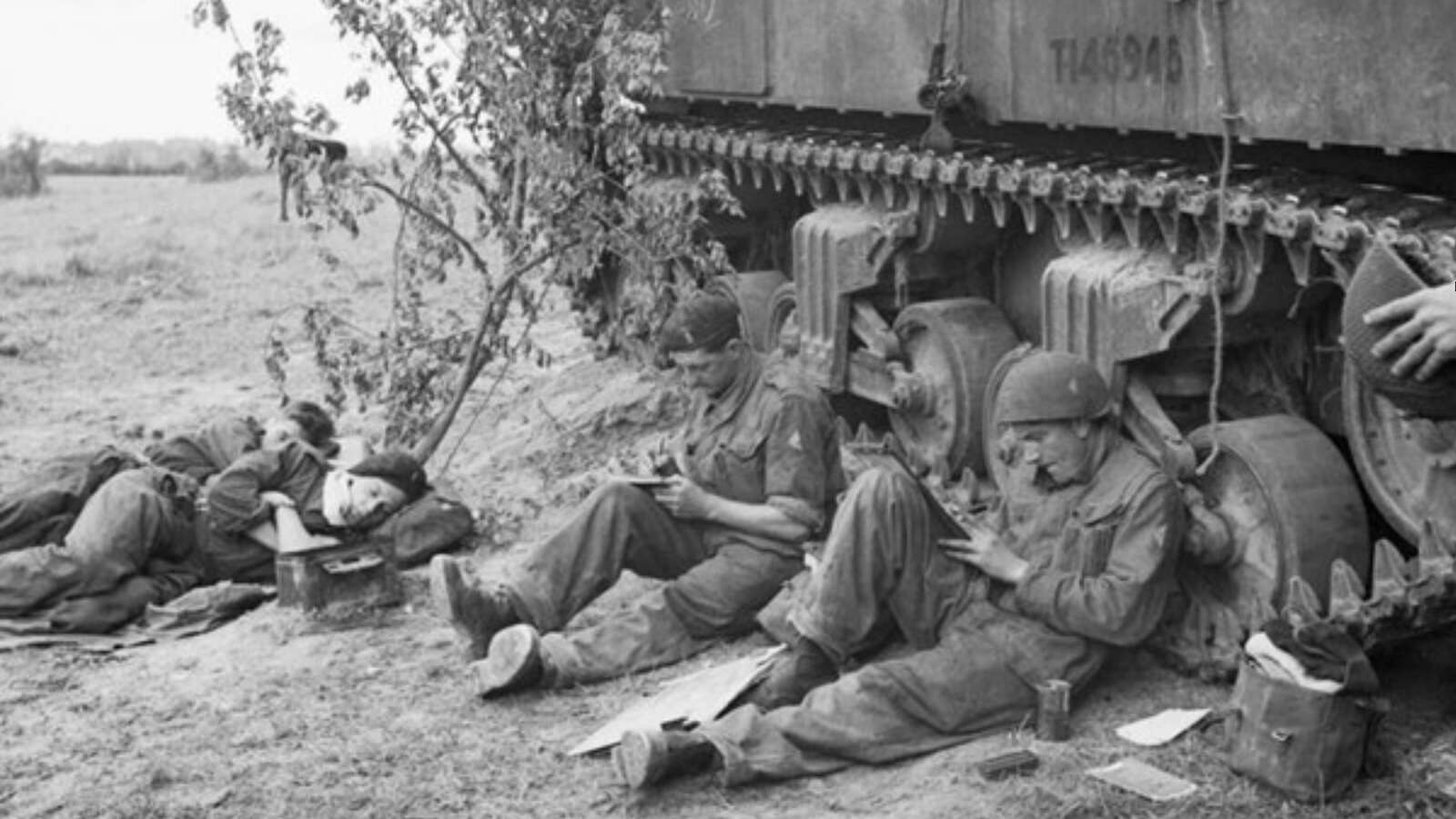
Imperial War Museum, ‘Sherman tank crew of 'C' Squadron, 13th/18th Royal Hussars, 27th Armoured Brigade, rest and write letters home by the side of their vehicle, 10 June 1944.’ Image: IWM (B 5425). Online: https://www.iwm.org.uk/collections/item/object/205201989
Pope, Lucas, Papers Please: A Dystopian Document Thriller (3909 LLC, 2013)
Prax, Patrick, ‘Are the Bullets Going over Our Head? Designed Ambivalence in the Representation of Armed Conflict in Games,’ in Sjöblom, Björn, Jonas Linderoth and Anders Frank (eds) Representing Conflicts in Games (New York: Routledge, 2022), pp. 153-170
Ruberg, Bonnie, ‘No Fun: The Queer Potential of Video Games That Annoy, Anger, Disappoint, Sadden, and Hurt,’ QED: A Journal in GLBTQ Worldmaking, 2(2), 2015, pp. 108–24
Soderman, Braxton, 2001. Against Flow: Video Games and the Flowing Subject (Cambridge, MA: MIT Press)
Zagal, José P., ‘War Ethics: A Framework for Analyzing Videogames’ Proceedings of DiGRA 2017 14.1 (July 2017) http://www.digra.org/digital-library/publications/war-ethics-a-framework-for-analyzing-videogames/