

About the Lecture
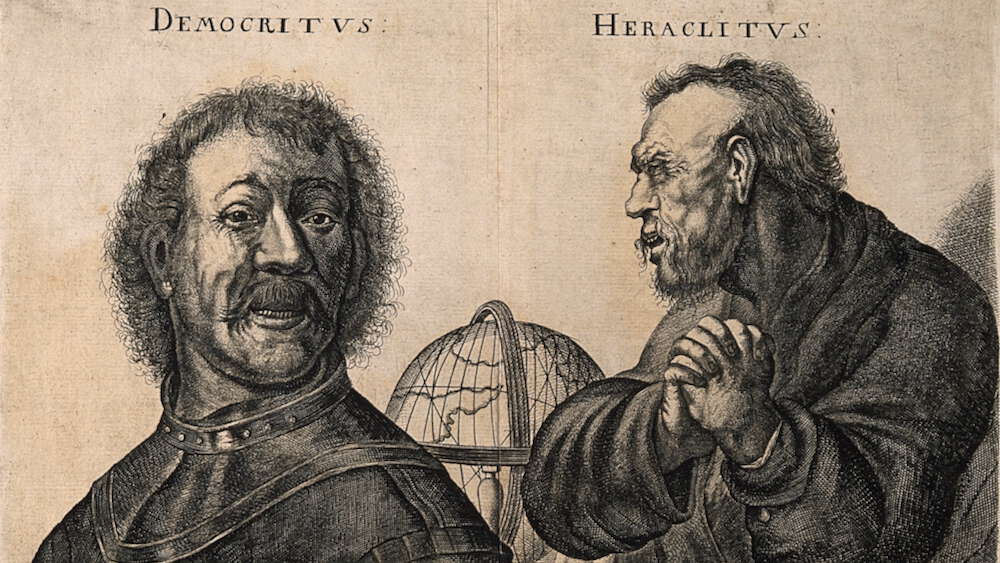
The contrasting pair of weeping Heraclitus and laughing Democritus is an iconographic commonplace of Early Modern literature, philosophy, and especially the visual arts. Its meaning is generally quite straightforward and not hard to understand: when the philosopher considers the self-destructive follies of most human beings, he can react either by weeping at them or by laughing at them. In antiquity too this idea is attested, but rather infrequently, especially in Latin texts. Trying to understand its origin and sources turns out to be a surprisingly difficult undertaking: its relation to the actual writings and reception of Heraclitus and Democritus is complex and problematic. This lecture attempts to trace out the pathways of its invention and development and makes some tentative suggestions about its genesis.
About the Speaker
Glenn W. Most is Visiting Professor in the Committee on Social Thought and Classics at the University of Chicago. Until 2020, he was Professor of Greek Philology at the Scuola Normale Superiore di Pisa, and he is an External Scientific Member of the Max Planck Institute for the History of Science in Berlin. Prof. Most was the first classical philologist to receive the Leibniz-Preis of the Deutsche Forschungsgemeinschaft (1994).
.jpg)
His work ranges across Classics and ancient philosophy, the history and methodology of Classical studies, comparative literature, cultural and religious history, literary theory, and the history of art. He has co-edited major comprehensive editions of the early Greek philosophers, as well as volumes on scholarly methods in canonical written traditions, mathematical commentaries in Greek, Babylonian, Sanskrit, and Chinese, myth and reason in ancient Greece and China, plurilingualism in the history of science, and the Derveni Papyrus.
Prof. Most’s current projects focus on ancient Greek philology and comparative philological practices worldwide, including an edition and translation of the scholia and commentaries on Hesiod’s Theogony, a volume on textual variants in pre-modern scholarly traditions, a study of the Annunciation in Luke and its reception in art and literature, and a global lexicon of indigenous terminology for philological practices.
Interested in Attending?
If you would like to attend, please register by the day before the lecture at: https://nettskjema.no/a/lorange.
About the L'Orange Lecture
Each year, the Director of the Norwegian Institute in Rome invites an internationally renowned scholar to deliver a lecture in honour of the Institute’s founder, Professor Hans Peter L'Orange (1903–1983). Further information about previous L’Orange Lectures can be found here.