
As of spring 2025, the Norwegian Institute in Rome will host selected affiliated researchers – scholars with strong connections to Rome and to relevant Italian research environments. The intention is to promote synergies and cooperations between the Institute and Italian researchers and academic milieus, as well as to facilitate collaborations between the affiliated researchers and the Institute’s postdoctoral fellows, guest researchers, and other scholars. Another aim is to raise the Institute’s visibility in Roman and Italian academic environments.
– The arrangement is aimed at researchers holding a PhD who either live in Rome or have strong ties to the city, explains Han Lamers, director of the Norwegian Institute. – They are primarily Italian early career researchers who wish to strengthen their international networks and establish connections with Norway and the Nordics.
Hopes of long-term collaborations
Whereas guest researchers at the Institute usually belong to one of the Norwegian partner institutions, the affiliates are part of Roman or Italian research environments. During the period of their affiliation, which is longer than that of a typical guest researcher, the researchers will work on projects relevant to the Institute's scholarly profile. They will have access to facilities such as the library and available office spaces and are expected to contribute to the academic environment at the Institute, for instance by participating in seminars.
– It is important to us that this affiliation not only exists on paper, Han says. – We hope that the arrangement will lead to closer ties between Italian and Scandinavian research networks, and to a stronger collaboration with Roman and Italian research environments long-term.
Anonino Nastasi and Maria Cristina Manzetti were the first to make use of their new status as affiliated researchers, starting in March and April, respectively. They are both looking forward to the next few months.
– A small, but stimulating community
Antonino graduated in classics at La Sapienza, and went on to do a PhD in Chieti-Pescara on modern-day Latin inscriptions. He is currently on leave from his teaching job at one of Rome’s licei classici to do a second PhD on the reception of Classical Antiquity at Tor Vergata University, with an end date in 2027.

Antonino has published several articles as well as a book and is on the advisory board of the database Fascist Latin Texts, of which the Institute’s director Han Lamers is one of the co-editors.
Living in Rome, it’s easy for Antonino to visit the Institute when he likes, both to do research and attend conferences and other academic events. – I am very happy to be part of this small but stimulating academic community, he says.
While appreciating being able to focus on his studies in peace, Antonino also looks forward to the breaks. These, he claims, always offer opportunities for interesting conversations with other researchers and the director.
Sicilian inspiration
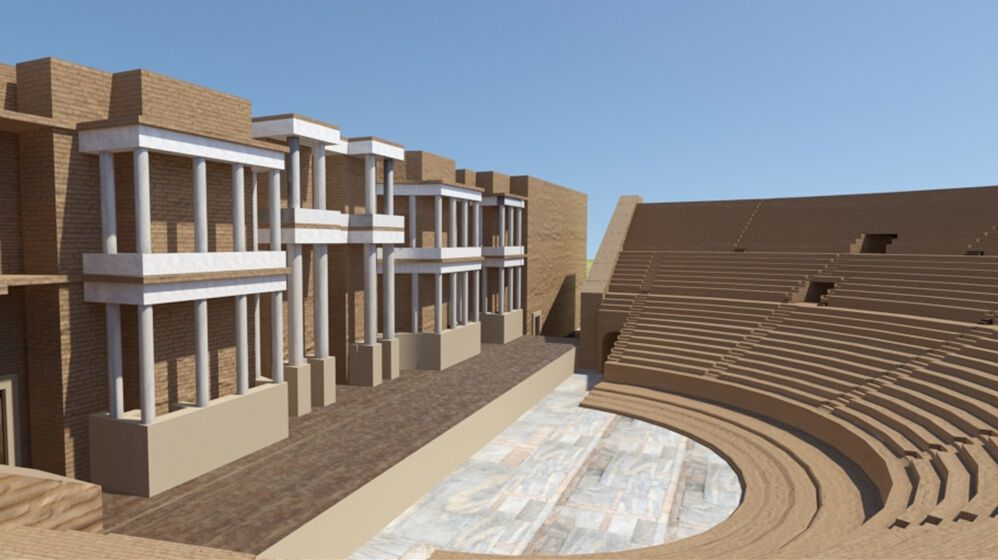
Cristina is a special scientist at the University of Cyprus and a member of the GrECI project, a collaboration between the University of Cyprus, the University of Oslo, and the University of Franche-Comté. Having studied landscape archaeology at Tor Vergata, she specialised in digital archaeology and did her PhD at the Technical University of Chania on the understanding and the valorisation of the Roman theatres of Crete.

– I have always been fascinated by literature, art, and the world outside my hometown of Castel Gandolfo, says Cristina, whose dream of becoming an archaeologist first emerged on a school trip to Sicily in her teens.
During Cristina’s time at the Institute, she plans to work on a book on the impressions evoked by the material heritage and places of the Mediterranean on 18th-century travellers from Central and Northern Europe.
– I hope I will be able to use the spaces of the Institute to organise workshops in the future, and to create a fruitful network to work on future projects.
Connections across disciplines
Martina Gatto is the third researcher to become affiliated with the Institute, starting in May. She is currently doing a three-year postdoctoral project at Tor Vergata, exploring the reception of Sparta in early modern thought. Since earning her PhD in Ancient History from Tor Vergata in 2020 with a thesis on the Spartan lawgiver Lycurgus, Martina has had several research stays abroad, including in Leuven and Fribourg.

As well as working on her postdoctoral project, Martina will spend her time as an affiliated researcher preparing an edition of two fragmentary ancient Greek historians, Sosylus and Sosibius. She hopes the Institute will provide a strong academic network and appreciates the opportunity to gain insights and inspiration from colleagues across disciplines – especially from those who are new to Spartan studies.
– I look forward to sharing my research at the Institute, says Martina. – The opportunity to receive feedback and build connections across diverse fields is invaluable for my personal and scholarly growth.
Fables, proverbs, and Byzantine Emperors
The fourth of the researchers, Lorenzo Ciolfi, will be starting 1 September. Trained as a Greek palaeographer at La Sapienza and continuing his studies at the Centre d'études byzantines at the École des hautes études en sciences sociales in Paris, he is currently a researcher at the Universidad Complutense de Madrid.

At the Institute, he plans to focus primarily on two aspects of his current research: the laudatory texts dedicated to the Byzantine Emperor John III Vatatzes (1221–1254) and the interaction between the literary traditions of fables and proverbs from Antiquity through the Middle Ages.
Lorenzo first became acquainted with the Norwegian Institute in 2011, when he participated in the DEEM programme (also known as the FIDEM course), an introductory course to manuscript studies with which the Institute has been involved for years.
– Now I return with renewed enthusiasm, Lorenzo says. – I am confident that my time here will help me address some of the more complex aspects of my research. At the same time, I hope to contribute to the Institute by sharing insights from Byzantine studies and sparking further interest in the intellectual traditions of the eastern Mediterranean.
Read more about the affiliated researchers on the Institute’s website.