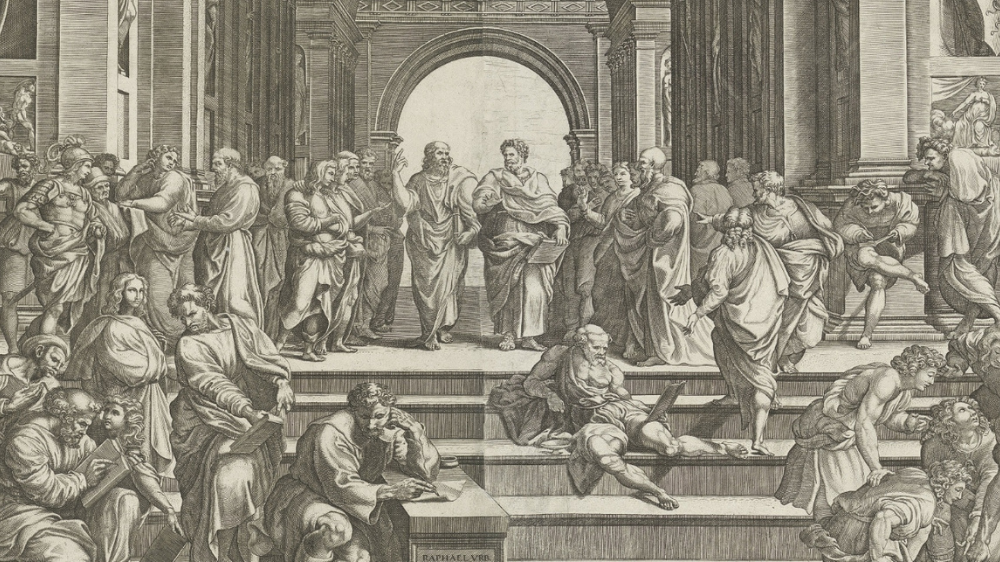
Focusing on early modern Europe (1500–1700), the project examines how ancient Greek culture was rediscovered, studied, and integrated into European intellectual and cultural life. By looking at books, languages, ideas, and material culture, the researchers seek to understand how Greek heritage became a shared point of reference for generations of Europeans.
– Our consortium seeks to deepen our understanding of why and how this heritage became a significant reference point for European identities, says Han Lamers, Director of The Norwegian Institute in Rome and one of the initiators of the project.
The project is a collaboration between the University of Oslo, the University of Cyprus, and the Marie and Louis Pasteur University in Besançon (France), with researchers ranging from PhD-students to professors. Lamers elaborates on the objectives of their research:
– How did people in the past engage with ancient Greek heritage? What access did they have to it, and how did they perceive it as something belonging to them—or not? What were the main developments in pre-modern Europe concerning this heritage? How did ancient Greece become a ‘common archive’ for generations of Europeans?
The researchers mainly examine these questions through four perspectives: the history of the book, language and literature studies, intellectual history, and material heritage studies. While the source material mainly consists of manuscripts and printed editions, Lamers emphasizes how the participants approach these sources with different perspectives and questions in mind. The French division explores the role of Ancient Greek sources in religious debates during the Reformation, while the Cypriot team explores printed editions of ancient Greek texts:
– They seek to understand where Greek books were printed, who their intended audiences were, why they were published, and how they circulated. This analysis is crucial for comprehending how and why people became familiar with these books.
Linguistic megalomania
The Norwegian team focuses on how the Ancient Greek language was understood and used in early modern Europe.
– Our postdoctoral fellow, Katharina-Maria Schön, has been exploring the philosophical poems that the humanist Daniel Heinsius (1580–1655) composed in Ancient Greek. Why would someone from the 17th century choose to write in Ancient Greek? What made this language relevant to them? How did they approach this, and for whom were they writing?
Part of the answer lies in how the Greek language was considered especially suitable for philosophy, as well as a prestigious language. To be proficient in Greek signalled a distinguished education.
Lamers is also researching the uses of Greek during this period. He is exploring how Europeans used Ancient Greek to promoted their own vernacular languages between the sixteenth and early eighteenth century.
– Early modern Europe was a time when vernacular languages increasingly emerged alongside Latin, profoundly transforming the literary and linguistic landscape of the continent. Interestingly, the rediscovery of ancient Greek language and literature played a decisive role in this process. Why? By comparing their languages to Ancient Greek, early modern authors could assert the ‘excellence’ of their native tongues in relation to other languages and Latin. The central question was: which language was the ‘most Greek’ and therefore ‘best’? Was it French, Italian, German, or perhaps Dutch?
According to Lamers, we’re wrong if we think Scandinavia wasn’t part of this. He elaborates on the Danish humanist Bertel Knudsen Aquilonius (1588–1650), who actually proposed a linguistic relationship between Danish and Ancient Greek.
– He went as far as to claim that Greek was basically a version of Danish and that the Danes had taken the language to Greece. So, the Greeks just mispronounced original Danish… Aquilonius pointed to the similarities between Danish and Greek words as evidence for his bold claims. This was a popular tactic for boosting the credibility of vernacular languages in early modern Europe, and some people went to great lengths to create extensive wordlists that showcased the ‘Greekness’ of their native tongues.
Lamers reminds us that this all took place long before linguistics became a formal field of study, so people were figuring out language relationships in ways we’d likely find strange or even downright funny today.
– These wordlists show quite some fantastic ‘similarities’ between the vernaculars and ancient Greek. What really fascinates me is how these seemingly ‘boring’ lists also got wrapped up in heated debates, like those between Catholics and Protestants or between Jansenists and Jesuits. These issues really mattered because they were tied to how people understood themselves and their place in the world. People were passionate about them. Sometimes, the past indeed feels like a foreign country...
Publishing-wise, the research group is working on several books with collected essays, as well as a thematic edition of Digital Humanities Quarterly, all Open Access. An edition of the letters of Manuel Chrysolaras, a leading figure among Renaissance scholars of Greek, edited by Chiara Gazzini, has been finished. She and Lamers are currently working on a few side-projects that have emerged over the years.
– Side projects can easily evolve into something more substantial, and we’ll see what the future holds!
Navigating International Waters
The team has been working on GrECI for almost three years, and the project is nearly at an end. During this time, research meetings have been organized, as well as workshops on professional skills such as writing cover letters and Open Access publishing, aimed at young scholars. Lamers emphasizes the latter as a key aspect of the project’s broader goal of creating conditions that promote research excellence and encourage the involvement of early career researchers.
– Through these activities, the University of Oslo plays an important role in bringing together young scholars internationally and preparing them for successful academic careers.
This October, a concluding conference is to be held in Nicosia in Cyprus (programme), as well as a wrap-up session where researchers and research administrators will gather to discuss the main takeaways and challenges. According to Lamers, administering an international collaboration has offered a few challenges, as well as new insights:
– Academia is a truly international field, yet universities can be organized quite differently, and research cultures can vary significantly from country to country. A key outcome of this project has been increasing awareness of these differences between countries and institutions, allowing us to work with them and find ways to navigate around them.
This is also one of the main goals of the Twinning-programme, which funds the project. Led by the EU, the programme is to promote smooth internationally collaborative environments between academic institutions.
– The aim of this funding program is twofold: it seeks to establish and expand an international research network among several institutions while facilitating the exchange of knowledge about research management. In addition to the academic program, there is a dedicated program for fostering exchanges between the research administrators of the participating institutions, as well as interactions between researchers and research administrators.
Twinning is not widely known in Norwegian academia, and GrECI is the first twinning-project granted to the humanities in Norway.
More information about the project’s objectives, team, and events can be found at the project’s website: https://greci-twinning.org/.
Lamers has previously published articles on the aforementioned Aquilonius (in the book available here), and on an epic victory poem composed in Ancient Greek by a sixteen-year old student in the Netherlands, which he has rediscovered in Royal Library of The Hague.