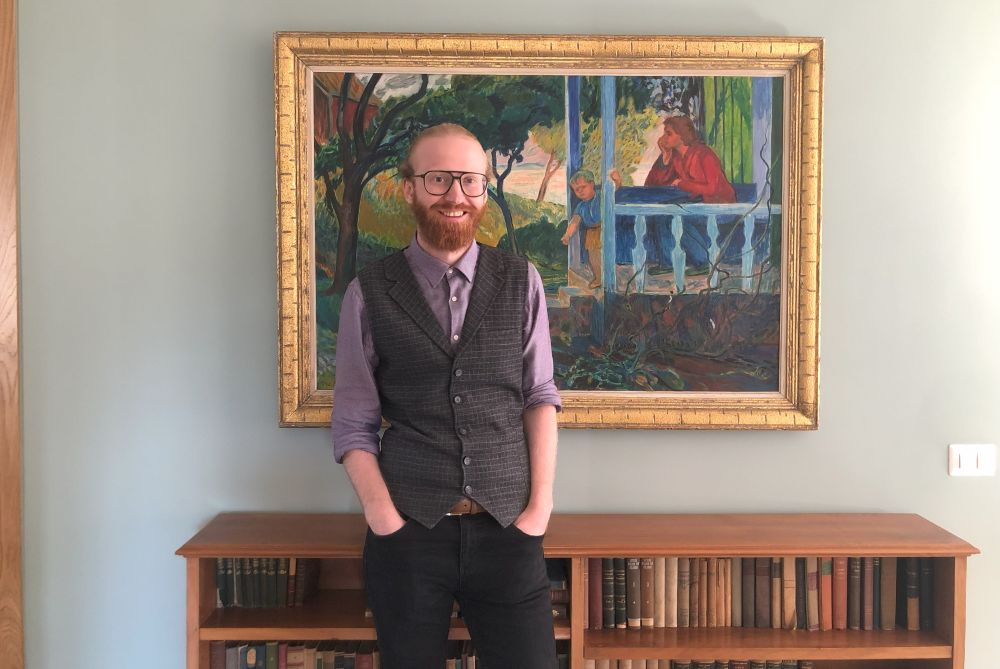
Martin’s career so far has been wide-ranging both geographically and chronologically. Born in a small town in southern Bohemia, he earned his PhD degree in Art History from the University of Poitiers and Masaryk University in Brno, with a dissertation exploring the interplay between key liturgical performances and monumental mosaic decorations in ninth-century Rome. He took part in a recently completed MSCA-RISE project, Conques in the Global World, which brought him to New York City and Rome as a visiting scholar. Before joining DNIR, he was based at the University of Regensburg, where he spent two years as a postdoctoral fellow of the Alexander von Humboldt-Stiftung, exploring late antique visual culture in Urbe while deepening his knowledge of medieval liturgical sources.
Martin is thus no stranger to Rome, neither in his research nor in his personal experience, but his interests also cover other areas, as well as periods beyond Late Antiquity and the Early Middle Ages. He has published on the impact of environmental factors on medieval visual cultures, late medieval art from the Czech lands, and the recontextualization of medieval artifacts in modern ritual practices and politics.
The power of images
- Why did you become an art historian?
- It is honestly quite difficult to pinpoint what sparked my interest in art history. As a teenager, I was already drawn to different visual languages, artistic expressions, and historical narratives, but that alone, I suppose, would not be enough to explain it. I would perhaps also credit two religious images – large prints – in my grandmother’s house, which hung next to the bunk bed where, as a kid, I usually slept on the upper level while my sister slept below. As I turned in my sleep, I sometimes brushed against them or even kicked them accidentally. Over time, I became aware of the tension between these images in a countryside home and the lived reality of a post-communist Czech small town where religion played only a minor role. Looking back, I think this contrast contributed to my interest in the role of art in society and historical change, though I might answer differently a few years from now.
Innovation versus repetition
Martin will be spending the next three and a half years conducting a research project here in Rome, where he will study the interactions between important liturgical performances and their visual settings in Roman churches, focussing primarily, but not exclusively, on the case studies of Santa Maria Maggiore, Santa Cecilia, and Santa Susanna.
- I want to find out how churches and their decorations were constructed, shaped, and re-shaped to serve their liturgical function across the centuries. In particular, I will examine masses on dedicatory saints’ feast days and papal stational liturgies, which were often celebrated by the pope himself in these ritual spaces, to identify moments where the monumental decorations and rituals intersect.
The tension between artistic innovation and the inherently repetitive nature of the liturgical annual cycle is fundamental to Martin’s research. He hopes to find out how liturgy impacted the conception and remodelling of monumental church decorations, whether in the medieval or early modern periods – his project covers both.
Inspirational Rome
- What aspects of this new position are you looking forward to the most?
- Every day, I eagerly anticipate the incredible view from my new office or the terrace of DNIR, a sight that continually inspires me. It truly is a privilege to live in Rome while writing about it. I deeply appreciate the access I have not only to the spaces I study and the conferences organized by various institutes across the city but also to libraries and archives with invaluable collections of essential publications, medieval manuscripts, and other sources I plan to analyse.
Martin’s position includes a significant amount of teaching, and he is looking forward to sharing his research on medieval and early modern art in Rome with the students.
- Engaging with them in situ, rather than solely in the classroom, will surely bring a unique dimension to our discussions and enrich the learning experience in a way that would be impossible elsewhere.