Rare combination of depth and originality
The academic jury highlighted Haug as an unusually strong candidate:
“The thesis represents a rare combination of academic weight, theoretical ambition and analytical sharpness. Haug combines historical subject matter with an advanced theoretical framework in a way that appears highly original and innovative.”
The jury also emphasized the thesis’s well-considered and engaging structure, alongside a broad and thoroughly documented source base.
As the prize winner, Haug receives NOK 10,000 and a stay in Rome for one month in the autumn of 2026. There she will have the opportunity to continue developing her project, both in the city itself and in the institute’s well-equipped library.
Five outstanding candidates
This year’s academic jury describes the nominees as “exceptionally strong”, with works demonstrating solid scholarly craftsmanship, wide-ranging knowledge and clear research talent. The nominees were:
Olav Carlsson (University of Oslo), with the master’s thesis “Julius Caesar’s Gallic War (De Bello Gallico) and the Principles of Bellum Iustum”
Sunniva Mundal Haug (University of Bergen), with the master’s thesis “Looking Antinous in the Eye. Approaching Antinous with Material Agency and the Psychoanalytical Gaze”
Anne Løddesøl (University of Oslo), with the master’s thesis “Angelic Hours. Temporal and Typological Structures in Honorius Augustodunensis’ De Neocosmo”
Sebastian S. Martens (University of Bergen), with the master’s thesis “Athenian Democracy in the Modern Era: A Reception-Historical Analysis of the Irish Citizens’ Assembly’s Use of Classical Athens as an Ideal for Design and Establishment”
Malin Nyfors (Oslo School of Architecture and Design), with the lecture “Goethe the Scientist in Rome”
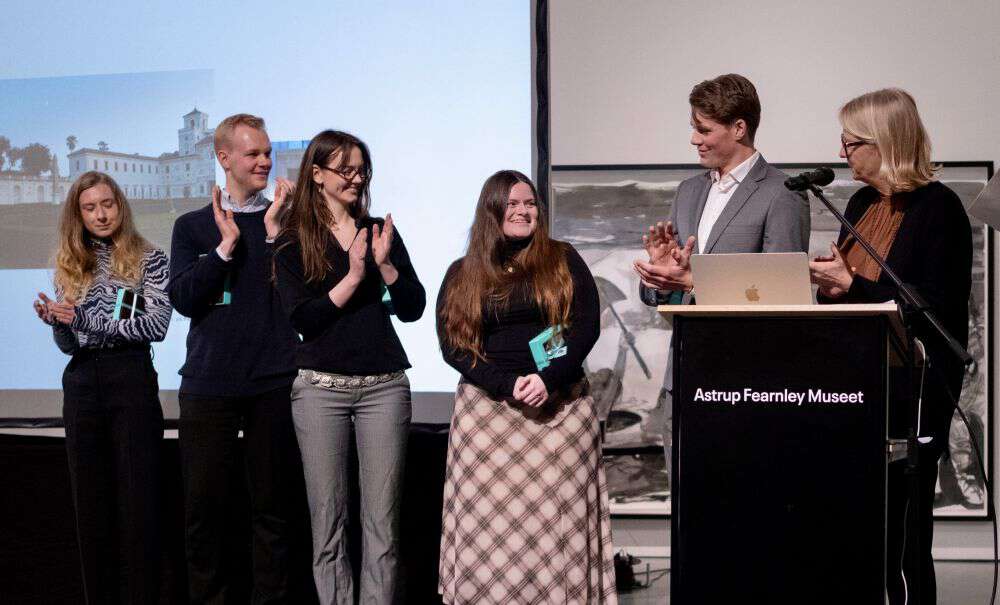
During the ceremony, Vice Dean for Research at the Faculty of Humanities, Ada Nissen, presented and praised the five nominees, underscoring how their work demonstrates both research quality and strong potential for further academic development.
Formal award ceremony at the Astrup Fearnley Museum
Around 100 participants attended the event. The programme opened with an introduction by Professor Han Lamers, Director of the Norwegian Institute in Rome, followed by an academic lecture on violence and power in imperial Rome by Professor Knut Ødegård.
The award segment began with a presentation of the candidates by Vice Dean Ada Nissen, before Cecilie Astrup announced the winner to great applause.
The jury consisted of:
- Unn Falkeid, Intellectual History, University of Oslo
- Hans Lamers, Classical Philology, University of Oslo
- Ada Nissen, Modern History, University of Oslo
- Åslaug Ommundsen, Medieval Latin, University of Bergen
- Victor P. Tschudi, Architectural History, Oslo School of Architecture and Design
- Tor Ivar Østmoe, Latin Language and Literature, University of Oslo
The celebration continued with mingling and a reception with Italian music and finger food in the Kiefer Room, catered by the Restaurant Ventiventi.
The award ceremony was part of the Humanities Festival organised by the Faculty of Humanities at University of Oslo. The prize, named after philanthropist and art collector Hans Rasmus Astrup, aims to highlight outstanding student work in the humanities and to strengthen ties between research communities, the Norwegian Institute in Rome and the broader public.
The forthcoming research stay at the Norwegian Institute in Rome will give Sunniva Mundal Haug a unique opportunity to further develop her work on Antinous in direct dialogue with the city’s artistic and cultural heritage – and to take the next step in a promising academic career.
More about Hans Rasmus Astrups Roma-pris for fremragende studentarbeid (in Norwegian only)