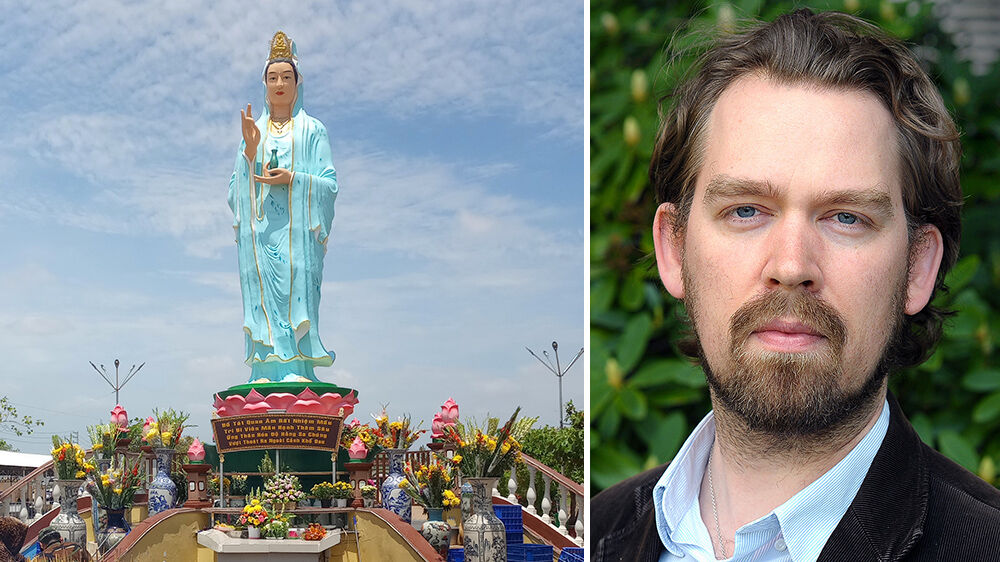
Professor of East Asian Religions, Aike Peter Rots, has been awarded nearly NOK 25 million from the European Research Council (ERC) through the prestigious Consolidator Grant. Together with an interdisciplinary research team he will explore goddess worship in East and Southeast Asia.
“The funding from the ERC means a great deal to me. It will make it possible to continue researching popular religion, rituals, sacred animals, the sea, and environmental change,” Rots says.
He has previously researched these themes extensively and led the recently completed ERC project “Whales of Power”.
“The grant is a major recognition of the work we have done, and it also confirms that more research is needed,” he adds.
A new approach
Goddesses such as Guanyin, Mazu, Benzaiten and other water deities are popular across much of East and Southeast Asia. They are often associated with the sea and rivers. Although these goddesses play central roles in the lives of billions of people, there is little research on how people relate to them in everyday life.
The new project, “Maritime Goddesses: Transnational Connections, Blue Environments, and Ritual Care in East- and Southeast Asia” (MARGO), will provide new and broader knowledge about goddess worship in Asia.
“The project will not focus on a single deity or tradition, but will compare different practices across time and space,” the professor explains.
People, goddesses and nature
Coastal areas in East and Southeast Asia are among the places where environmental and climate changes are most visible. How are people’s rituals and religious practices affected by these changes?
Aike Peter Rots and the rest of the research team will examine the relationships between people, gods and goddesses, and the nature around them.
“We need new concepts and methods to study this. As part of the project, we will develop a new theory of ritual.”
Rots recently also received funding from the Research Council of Norway for the project “Coastal Lives in Flux” (CLiF). He sees this as a major advantage:
“It means I can assemble a larger team with broad expertise. We will work across the boundaries of religious studies, area studies, social anthropology and environmental humanities. I’m really looking forward to this big new adventure.”
A strong achievement
Dean of research, Ada Nissen, congratulates Aike Peter Rots on behalf of the Faculty of Humanities.
“This is a strong achievement! The new project is both creative and innovative. Rots is now receiving ERC funding for the second time, that clearly illustrates that one can build stone upon stone and further develop humanities research at the highest level,” she says and adds:
“I am proud that the faculty is once again performing well in international competition”.
Read more: