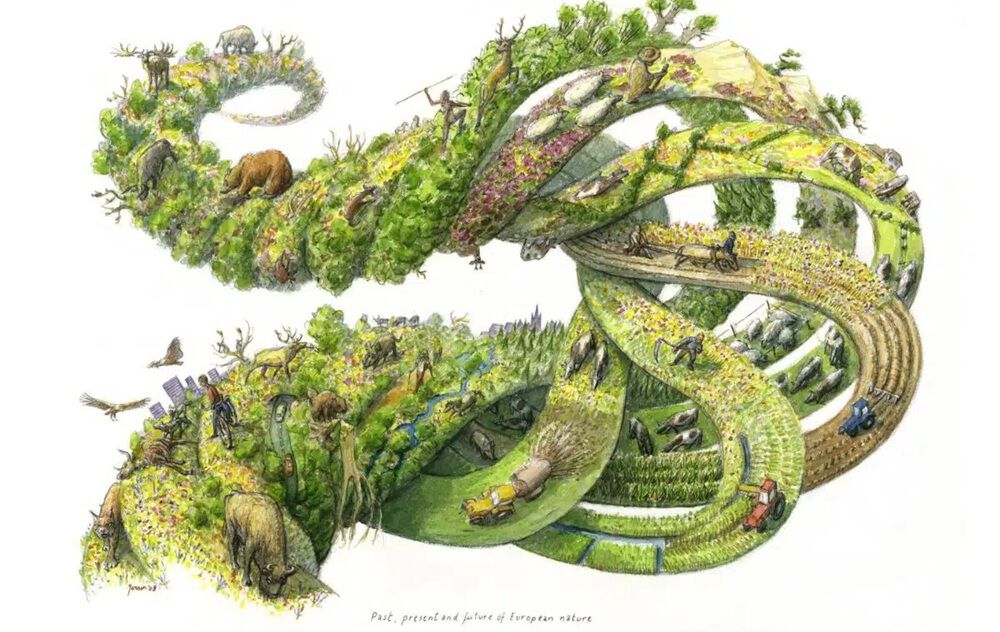
Rewilding is a new approach to wildlife conservation that challenges the temporalities of orthodox approaches to identifying and securing desired environments. It encourages conservationists to look to deeper pasts and further futures as they formulate appropriate reference points for the Anthropocene. It figures conservation less as the prevention of species extinction and more as the choreography of ecological processes to secure desired functions and services.
This paper develops and applies a novel conceptual framework for critically examining rewilding by drawing together cognate literatures from political ecology, environmental philosophy, time studies, and queer and disability studies to theorise its chrononormativities and chronobiopolitics.
The analysis comes in three parts. First, it examines the normative political strategies of baselining and horizoning through which pasts and futures are mobilised to legitimate present rewilding practice. Second, it explores the environmental biopolitics through which temporal rhythms are choreographed in practices of rewilding, including how processes of ecological succession are curated and how rewilders deal with unexpected events. The final part critiques the emerging chrononormativities and chronobiopolitics of rewilding and advocates for alternative models more conducive to multispecies flourishing and resistance in more-than-human crip ecologies.
The analysis largely focuses on the use of large herbivores and native trees to enable afforestation in Europe, while also referring to examples of rewilding elsewhere. The conclusion identifies priorities for future research on time in conservation and calls for continued conceptual engagement at the interface of political ecology and queer and disability theories.
Bio
Jamie Lorimer is Professor of Environmental Geography at the University of Oxford. His research explores environmental governance across different scales. Past projects have examined the histories, politics, and cultures of wildlife conservation, spanning topics from elephant conservation to microbiome manipulation. He is the author of Wildlife in the Anthropocene: Conservation after Nature and Probiotic Planet: Using Life to Manage Life.
His current research explores transitions in agriculture and conservation in the context of growing concerns about the relationships between farming, biodiversity loss, and global heating. He is currently working on a book entitled What’s Your Beef? Why We Disagree About Cattle.