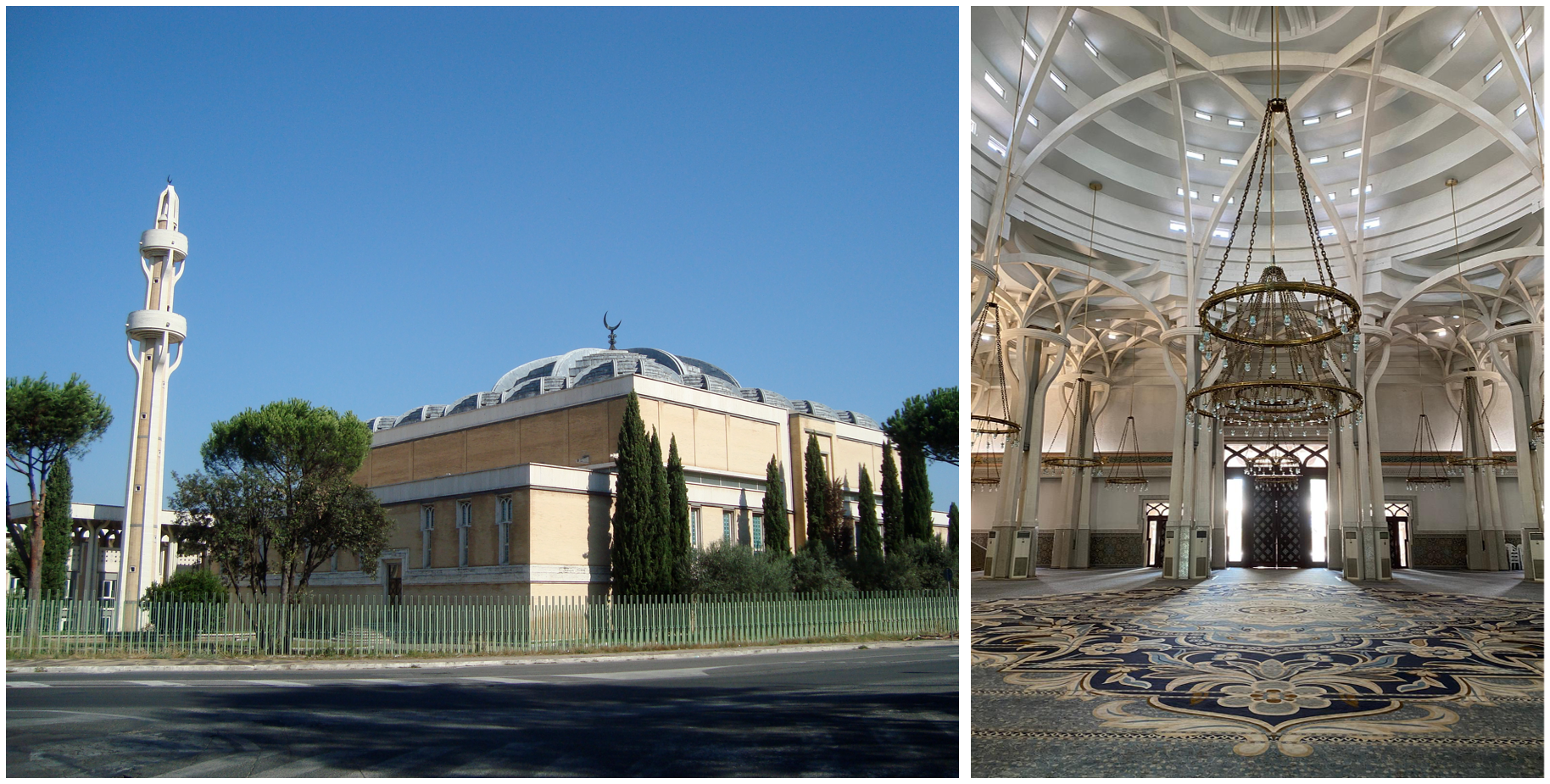
In recent decades, scholars of religion have increasingly incorporated methods from other disciplines even while continuing to privilege the historical perspective. To investigate the spatial dynamics of religious interaction, a transdisciplinary network of historians of religion, anthropologists, architects, geographers, sociologists, and art historians has created the Sharing Religious Places (ShaRP) Lab.
Together, its members adopt different angles and methods – from the emic gaze to the social framework, from the historical-critical method to that of the social sciences and digital humanities – to open new horizons in the study of (also) shared religious places.
In this talk, Maria Chiara Giorda will present the ShaRP Lab, its manifesto, and its collaborative research on the Great Mosque of Rome. Giorda’s presentation builds on her article “History and heritage of the Great Mosque of Rome: Interdisciplinary approaches through the space”, which recently appeared in a special issue of Historia Religionum (issue 16, 2024).
Maria Chiara Giorda is a professor of the History of Religions at Roma Tre University. She works on religious education, the geography of religions, the history of monasticism and religious diversity in public places.
The presentation will be in English.