To join via Zoom, use the link in the email announcement. If you haven’t received it, contact Alexandra Bogoyavlenskaya.
Abstract
The talk will focus on cross-linguistic influence (CLI) in multilingual children aged 6–12 years speaking East Slavic home languages (Ukrainian or Russian) and residing in Germany, Spain, Poland, and the Czech Republic. We will explore how structural similarity between properties, cue salience, age-of-L2-onset and their interaction predict the direction and strength of grammatical CLI in multilingual contexts. The findings draw on two projects that investigate bidirectional CLI in the domains of nominal case and verbal aspect - areas known to be vulnerable in heritage speakers.
The first project focused on Russian-speaking children growing up bilingually with German or Spanish as their societal language. We used Visual World eye-tracking and tested the children in both their heritage (Russian) and societal languages. The bilingual groups were matched by age, overall exposure, and lexical proficiency in the heritage language. The selection of the populations was motivated by structural overlap between the languages: while both Russian and German mark grammatical case (nominative vs. accusative) overtly in noun phrases, Spanish does not employ overt case marking. On the other hand, Spanish and Russian share similarities in their use of verbal aspect (perfective vs imperfective) to distinguish between completed vs ongoing events in the past, while German doesn't grammatically mark aspect on the verb. We make comparisons across the two bilingual groups in the heritage language as well as with monolingual controls in the societal language. The results highlight the role of cue salience in shaping the direction and extent of CLI (societal to heritage and heritage to societal language).
The second project extends this investigation to multilingual Ukrainian refugee children residing in Poland and the Czech Republic and focusses on structural variations within Slavic languages. Specifically, we investigated the use of accusative plural marking for animal referents (which is syncretic with genitive in Ukrainian but with nominative in Polish) and the use of perfective aspect is habitual contexts (grammatical in Czech but not Ukrainian or Polish). By analysing production data and acceptability judgements paired with pupillometry, we investigated how structural (dis)similarity between languages, age-of-L2-onset, and their interaction predict the direction and strength of grammatical CLI from the L1 to the L2 and vice versa.
Bio
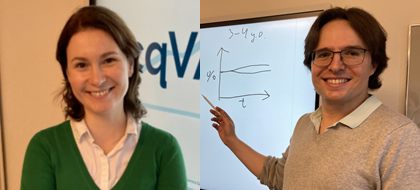
Natalia Mitrofanova is a Professor at UiT and Leader of the Language Domain at C-LaBL. Natalia is driven by the question how people - children and adults - acquire, use and maintain linguistic knowledge across one or multiple languages. She is interested in how linguistic representations are organized in the mind and how they are connected and interact across the multiple languages a speaker knows. She uses psycholinguistic methods to study this.
Serge Minor is a Senior Researcher at UiT and Lab Director at C-LaBL. Serge’s primary research interests lie in the area of semantics and psycholinguistics, and the application of experimental methods to the study of language meaning. He is also interested in multilingual acquisition and attrition (2L1, L2 and L3) and statistical methods, including non-parametric resampling and Bayesian modelling.