Register here if you want to attend (for non-presenters): nettskjema.no/a/512924
Program
Friday 2 May
- 09:00 Registration with coffee and fruits (Salen, ZEB-building 1U71)
- 09:30 Welcome and opening talk
- 09:45 Session 1: Platforms and music making (Chair: Emil Kraugerud)
- Bondy Kaye & David Hesmondhalgh: What do musicians think of digital platforms? A focus group study of musicians and platformization in England.
- Carsten Wernicke & Jan Herbst: The platformization of songwriting: An exploration of the Interplay between technological constraints, creative agency, and cultural production
- Vemund Hegstad Alm & Ragnhild Brøvig: The emergence and potential decline of cloud-based sample platforms
- 11:15 Coffee break
- 11:30 Session 2: Making platforms (Chair: Øyvind Skjerdal)
- Emil Kraugerud: Concepts of music production in digital audio workstation interfaces
- Rosa Stilgren: Programming particularities (in Ableton Live)
- 12:30 Lunch
- 13:30 Keynote talk by Paul Théberge: Any Sound an AI Can Imagine: Making music in the age of platform culture (Chair: Yngvar Kjus)
- 15:00 Coffee break
- 15:15 Session 3: Music in the age of TikTok (Chair: Fabian Stordalen)
- Håvard Kiberg & Hendrik Spilker: The remix turn in music streaming, finally? On the hybridization of production, distribution and use in modern streaming platforms
- Anders Bach Pedersen: There are two forms of platform music on TikTok
- 16:15 End of program
- 17:00 Reception (drinks and light food) (HF12, Niels Treschows Hus)
Saturday 3 May
- 09:00 Coffee & Fruits (Salen, ZEB-building 1U71)
- 09:30 Session 4: Negotiating production platforms (Chair: Emil Kraugerud)
- Øyvind Skjerdal: DAW affordances and musical projects: The technological work of music making
- Ellis Jones: Cheap music? The role of AI platforms in the production of library music
- Yngvar Kjus & Fabian Stordalen: Jumping from platform to platform: How game music composers negotiate the industries of music, games and technology
- 11:00 Coffee Break
- 11:15 Session 5: Networked music communities. Online. (Chair: Øyvind Skjerdal)
- Spandita Das: Dual aspects of platformization of Jhumair: Construction, continuity, and preservation of a musical tradition at the grassroot level
- Lijuan Qian: Curating on digital social media platforms from ethnic minority musicians in China
- 12:15 Lunch
- 13:15 Session 6: Interacting on platforms (Chair: Yngvar Kjus)
- Rasmus Riegels Sørensen: For your streaming pleasure: Livestreaming music production as content across platforms
- Baptiste Bacot: Mr. Bill: a case study of the entangled platforms of electronic music production
- 14.15 Coffee break
- 14.30 Session 7: The experience of platforms (Chair: Fabian Stordalen)
- Joseph Coughlan-Allen: Functional Streaming (of lo-fi hip-hop)
- Håvard Kiberg & Anja Nylund Hagen: Mood, focus, engagement? Framing attention in the digital, platformized music culture
- Nicolas Ruth: S.T.R.E.A.M.: Streaming Technology Research: Effects on Artists and Music Production
- 16:00 Summary and closing comments
- 16:15 End of program
- 18:00 Optional dinner/drinks: Vippa, foodcourt in downtown Oslo. You can check out their menu here.
Watch stream
(NB! Unfortunately, the stream will be paused during Paul Théberge's keynote presentation.)
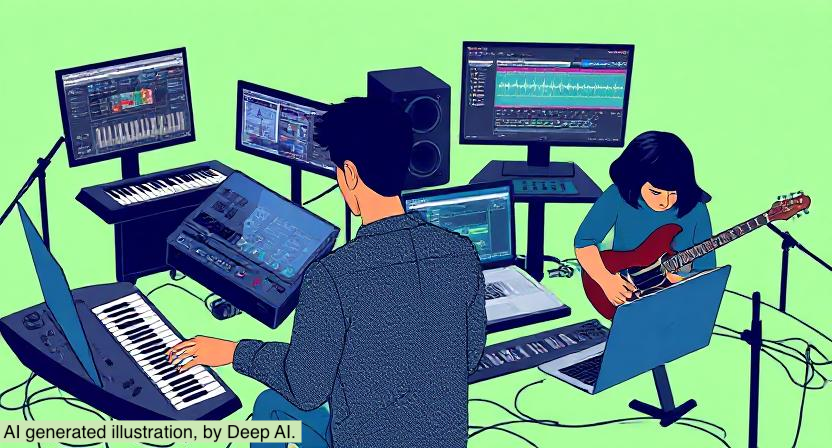
This symposium asks how contemporary platforms of music production are developed and what their significance might be for music making. We thereby invite explorations of platformization in terms of the technological platforms as well as the implications for “platformized” creative practice.
The basic meaning of “platform” is a “raised level surface on which people or things can stand” (Oxford English Dictionary), and it has been associated with networked services that are able to accommodate a growing range of users and somehow transform the relationship between them (e.g. Gillespie, 2010).
The notion of platformization of music making has perhaps primarily been associated with distribution services, such as Spotify, and the way songwriting is influenced by recommendation systems and mood-based playlists that promotes listening (e.g. Morris 2020, Kiberg 2023).
Recent research has also engaged with the platformization of production resources, such as online services offering automated mastering (Landr; see Sterne and Razlogova 2020) or royalty-free samples (Splice; see Arrieta 2021).
Digital audio workstations, such as Apple’s Logic Pro or Ableton’s Live, increasingly resemble what Foxman (2019) calls “platform tools,” that are “integral to the entire production process” and able to “act as an intermediary between industries and platforms.” These technologies increasingly offer opportunities of online production and real-time collaboration while also providing networked distribution facilities.
Social media platforms, such as TikTok, are also integrating creative and distributive activities in new ways, while AI-based platforms offer new opportunities (and challenges) for music producers as well as consumers of music.
The symposium encourages a broad approach to the platformization of music production, including the “intricate interplay” between platforms and users, and its cultural, social and economic aspects (see Nieborg and Poell 2018).
Platforms have the appeal of being able to support a growing range of people and practices and to somehow transform the relationship between them, for instance within the field of do-it-yourself musicking. Research has, however, increasingly engaged with who and what platforms actually support and how interactions and practices might be organized to the benefit of certain interests over others.
We want to inspire further research by drawing attention to the rise of what we propose to call “platforms of production” and to the evolving range of digital and networked tools and services that in various ways facilitate and restrict contemporary music production and creative audio work in general.
Contributions
We invite theoretical, empirical, analytical, critical and conceptual contributions on topics including, but not restricted to:
- The development of contemporary technologies and platforms of production, including digital audio workstations, plugins, AI tools, sample libraries, etc.
- Relations between production and distribution platforms, and their joint influence on music making.
- The platformization of creative practices and changing competency requirements.
- The extension of platforms across sectors and markets of music. What kinds of labor relations and roles do platforms of production invite?
- The collection and use of data through platforms, including potential implications for creative practice (including ethical and legal issues).
- The use of artificial intelligence in existing and emerging platforms.
- Emerging complimentary platforms and services, from specialized AI mastering tools (e.g. Landr) to aggregate services (e.g. Splice). Do we see the contours of a platform ecosystem of music making?
- The significance of platforms of production for music making and sound design in audiovisual media (including interactive video games).
- The influence of platforms of production on the economy and business of music making.
- The influence of platforms of production on musical expression and aesthetics.
- Platformization and challenges to established notions of creativity, ownership and copyright.
- Sociopolitical implications of the use of different kinds of platforms, including diversity in music production culture and practice.
With these suggested topics we encourage contributions from, and indeed across, the scholarly fields of music research, media studies, cultural studies, sociology, creative industries research, software studies, and beyond.
Paper format and abstracts
We invite proposals for 20-minute presentations (with 10 minutes for Q&A). The symposium will be organized as an in-person event, with limited possibilities for remote presentations. The deadline for submitting abstracts has passed.
Publication
Based on the theme of the symposium and its paper contributions, we will work towards publishing an edited collection with an international academic publisher. Presenting authors will in that case be invited to submit a full paper for peer review and inclusion as a chapter of this book.
For any questions, please contact Yngvar Kjus at yngvar.kjus@imv.uio.no or Emil Kraugerud at emil.kraugerud@imv.uio.no.
References
Arrieta A (2021) Splice and the platformization of hip hop production: Navigating the online music platform for royalty-free samples, Global Hip Hop Studies 2(2), 219–236. DOI: https://doi.org/10.1386/ghhs_00045_1
Gillespie T (2010) The politics of platforms, New Media and Society 12(3), 347–364. DOI: https://doi.org/10.1177/1461444809342738.
Kiberg H (2023) (Plat)formatted creativity: Creating music in the age of streaming, Cultural Sociology, online first. DOI: https://doi.org/10.1177/17499755231202055
Morris JW (2020) Music platforms and the optimization of culture, Social Media and Society 6(3). DOI: 10.1177/2056305120940690.
Nieborg DB and Poell T (2018) The platformization of cultural production: Theorizing the contingent cultural commodity, New Media and Society 20(11), 4275–92. DOI: https://doi.org/10.1177/1461444818769694.
Sterne J and Razlogova E (2021) Tuning sound for infrastructures: Artificial intelligence, automation, and the cultural politics of audio mastering, Cultural Studies 35(4–5), 750–770. DOI: https://doi.org/10.1080/09502386.2021.1895247
