Audun Bakk and Linus Storvik Øgrim took three history courses offered by the University of Oslo's Department of Archaeology, Conservation, and History (IAKH), studying at the Norwegian Institute in Rome from 15 January to 29 May 2026.
"Nothing is like you, Rome, even though you are as good as a ruin. Ruined, you show how impressive you were as a whole."
That is how Hildebert of Lavardin described Rome around the year 1100. Even though a lot has changed in the last 900 years, his words still ring true. We’ve been able to see that for ourselves through excursions, seminars, and readings in the three courses we’ve taken at the Norwegian Institute in the Eternal City.

We began our stay with the course HIS2100: Rome – City and Empire in Antiquity. As the title suggests, it covers the Roman Empire from the founding of the city to the fall of the Western Empire, with a particular emphasis on the role of the city of Rome itself. This is Rome at its most important – even if our medieval professor, Hans Jacob Orning, might not entirely agree. On the excursions you visit the key sites of ancient Rome, such as the Forum, the Palatine Hill, and Ostia. These are places we guys think about pretty much every day anyway, so it feels good to build some proper knowledge on the topic. It’s especially motivating to work through dry academic texts when you know that the next day you might literally be standing in the place you’ve just been reading about.
Next, we took HIS2145: Rome as a Pilgrimage Destination in Medieval Europe. Rome continued to be an important city after the empire fell, albeit on a smaller scale. Even though the population dropped by about 98%, there is still a lot to learn. You might have the impression that the Middle Ages are just one long period of decline, especially in the Eternal City, but in this course, we learned that, in many ways, things were rather transformed into something new. The city’s centre of gravity shifts from the Palatine to the Lateran, and with the spread of Catholicism, Rome once again becomes a power centre in Europe. In many respects, it is the medieval period that allows us to keep calling Rome “the Eternal City,” instead of seeing it only as ancient history. During the course you visit a range of important sites, such as Castel Sant’Angelo and enough churches to last you a lifetime. With someone on hand who really knows the material, you can actually get answers to all the questions you’ve been sitting on.

The final course was HIS2940: The Myth of Rome in the Risorgimento and Under Fascism. Here we looked at how Rome’s legacy was used, or abused, as propaganda during the unification of Italy and under Mussolini’s regime. Unsurprisingly, this is the course that feels most relevant to the times we live in. It is also, in many ways, the most challenging. Compared to the two first courses, it is more heavily based on reading and seminars. However, in this course, too, we enjoyed many excursions, for example to the EUR district and the Victor Emmanuel II Monument. Since this is a much more recent field of history, the scholarship is shaped by a broader range of approaches, and we explored, among other things, the many different ways historians have interpreted Italian Fascism.

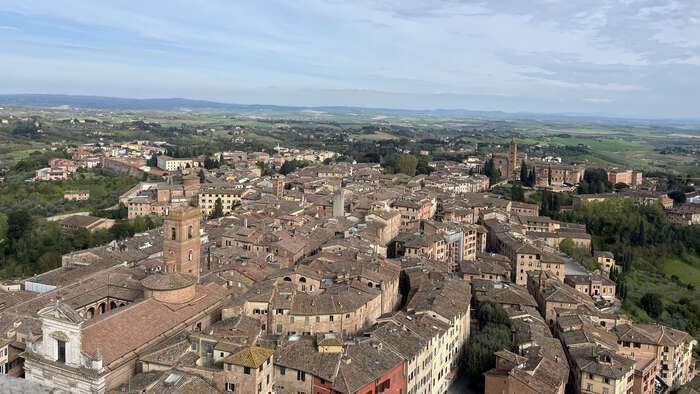
Still, the best part of the stay has probably been Rome itself. As UG so neatly put it: “We can see Italy, we can eat pasta, my bro.” There is just something about Italy. The food, the language, the sun – it almost goes without saying. Rome is inescapably historical: you find yourself walking past world-famous monuments almost every day, without really planning to. It takes a few weeks before it truly sinks in that you’re actually living in Rome, and not just there on a short holiday. There are countless museums, restaurants, and churches you can visit whenever you feel like it. And if it all gets to be a bit too much Rome at once, you can always retreat to the Institute.
For us students, the Norwegian Institute in Rome is open from early morning to late at night, every day of the week. The library has all the works you could possibly need, and you can visit the other foreign institutes in Rome to see what they have to offer. Students can also use the splendid top floor. There we have a kitchen, a living room, and a great opportunity to soak up the sun on the roof terraces. There are also seminars in the daytime and evening several times during the semester. Guests come in from all across the academic landscape in Rome and from abroad, so you get a chance to learn widely, far beyond the specific courses you’re enrolled in.

On the practical side, there is a lot to learn from spending half a year abroad. There are many ways to adapt your stay in the city to your own needs. Among the students who have been here this spring, some have shared a flat, some have lived alone, and others have stayed in shared housing with people outside the program. Each option has its pros and cons. Audun has been living on his own. That has probably spared him some of the headaches the others may have had from sharing a place with people they didn’t know very well. On the other hand, Linus has saved a lot of money by living in a shared apartment.
In general, some things are cheaper and others more expensive than in Norway. Buying a new phone costs more or less the same as back home, but you can easily get a cappuccino for €1.50. The typically Italian things that cost a small fortune in Norway are good and affordable here. Pizza, pasta, and Peroni at prices that mean even a broke student can treat themselves when they feel like it.
Interested in studying in Rome in the autumn of 2026? The Norwegian Institute in Rome is offering the course ROMA2020: Rome as Place and Symbol – a multidisciplinary introduction to the City’s rich history from antiquity to the present, where Rome itself is your classroom. The application deadline is approaching, so don’t wait too long to apply! If you would rather study there in the spring, you can choose the courses we took or other courses; see the webpages for details.