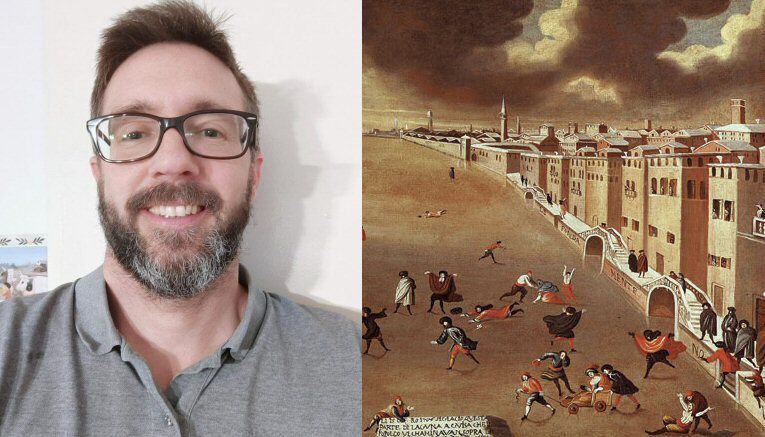
Nicolas Maughan (Aix/Bern)
Many historical documents and textual archives contain information with more or less detailed data about extremely long and cold winters for historical times. Moreover, nowadays, available temperature reconstructions for different regions, based on instrumental, documentary and natural proxy data, provide useful information to accurately locate particularly cold years/clusters of years or long-lasting frost periods. The climatic origin of these episodes can also be determined precisely, for example by identifying the type of internal or external climatic forcing involved (solar or volcanic forcing).
Although negative impacts, such as shortages, famines or the emergence of infectious diseases, due to extreme climate events have already been the subject of several academic works many other environmental aspects still remain overlooked.
One of the most famous cases in the early 18th century is the Great European Frost of 1708/09 (due to internal climate variability). After massive tree mortality in many European regions, at local and regional scale, wood markets were “glutted” by logs and deeply disrupted for several years; the trade and export of many species of trees, such as walnuts, strongly regulated. In Southern regions, like the South of France, the sudden and unexpected death of almost all olive trees (probably millions) has led to a long-term collapse of regional olive oil production, deep changes into cultivated lands but also a migration of artisans and oil workers – and their know-how - to other South European countries (especially northern Italy). For the natural sciences and climate sciences, this winter also marks the first step in the birth of dendrochronology. Indeed, in 1737, French naturalists Georges-Louis Leclerc de Buffon and Henri Louis Duhamel du Monceau described for the first time frost rings produced by the cold in 1709 on plants1.
During this lecture I will explore rapid and short-term socio-environmental consequences as well as long-term changes related to agriculture, livestock farming, forest resources exploitation, etc… induced by adverse effects of this extreme cold event in Europe.
This presentation should be understood as a small part of a larger study covering the whole of Europe from Scandinavia to the Mediterranean, involving climate historians from several countries.