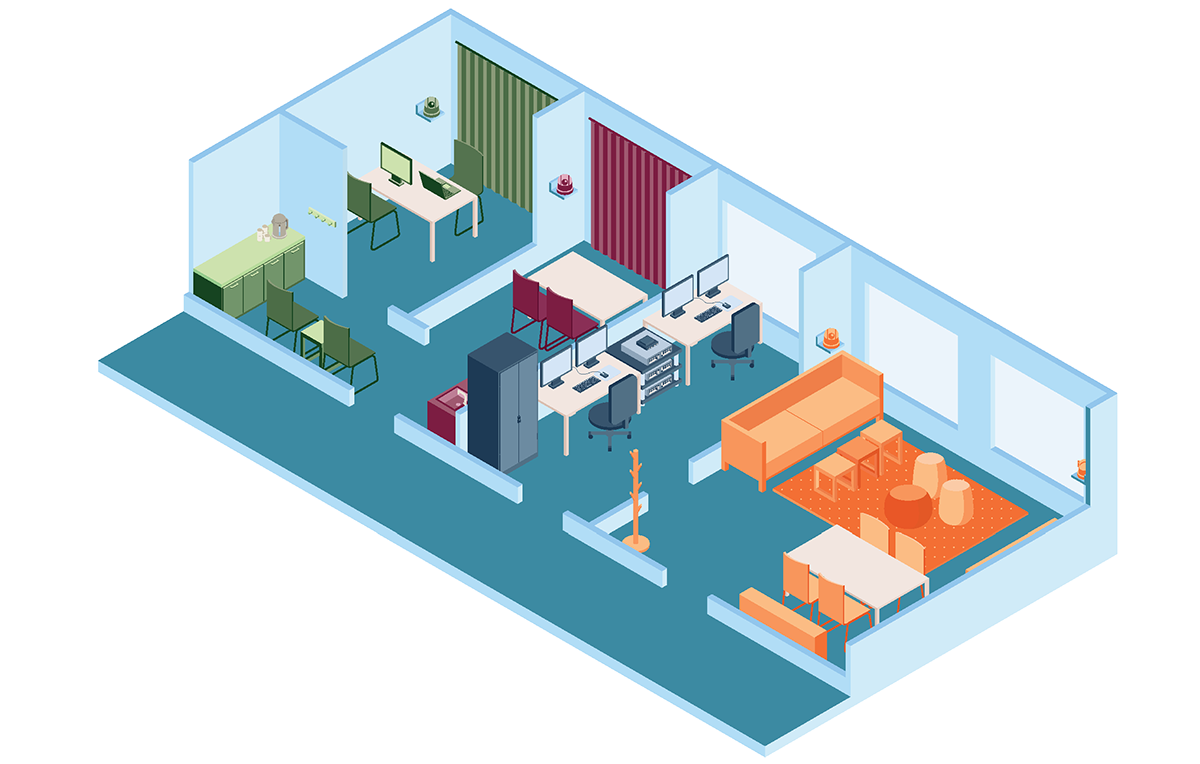
This animation offers a virtual tour of the lab.
 Video studio (room 113)
The video studio is equipped with 4 PTZ Full HD cameras, placed in the 4 corners of the room on pegs to adjust the height of the lens. The audio is recorded primarily from the microphones hanging from the ceiling, or additionally from 4 clip-on microphones. All the cameras get the same audio mixed in their video files with minimal drifting between sound and video. The video studio is ideal for conducting, for example, focus-group interviews of participants of all ages, studies of gesture, and collection of conversational data.
 EEG room ("pink" room, 115)
The EEG room is equipped with a 128-channel EEG system from BrainProducts. With EEG, we are able to measure electrical activity in the cortex via electrodes on the scalp and investigate online cognitive and sensory processes. EEG is a widely used and safe method that can be applied for various questions spanning from infant language acquisition to language comprehension processes in adults.
 Eye-tracking room ("green" room, 116)
The downstairs eye-tracking room has a SMI RED 250 mobile eye-tracker that is portable and suitable for testing inside and outside of the lab. With eye-tracking, we can measure participants' gaze to objects or events by tracking the position of the pupil and corneal reflections. Because there is a strong link between visual attention and cognitive processes, eye-tracking can provide insights into how different types of speakers understand, process and plan speech.
Adult EyeLink room (440)
The EyeLink room on the fourth floor of Henrik Wergelands house has one EyeLink 1000 Plus eye-tracker primarily for use on adults. This system, which one might be tempted to call the Ferrari of eye-trackers, has a sampling rate of up to 2000 Hz and allows for very precise tracking of eye gaze and pupil dilation in infants, children and adults. The EyeLink is thus suited for conducting eye-tracking studies that require a lot of precision, for example reading experiments.
Child EyeLink room (431 and 429)
This room also houses an EyeLink 1000 Plus eye-tracker, but is set up in a way more suitable for children and toddlers. Adjacent to the eye-tracking room is a welcoming area with childrens toys where participants can get comfortable before testing.
Portable equipment
-
EyeLink Portable Duo
The EyeLink Portable Duo is a portable eye-tracking system that provides accurate eye-tracking in a wide range of research scenarios. The Portable Duo comes with a designated MSI laptop and carrying case for out of lab use.
-
Pupil Labs Neon eye-tracking glasses
The Pupil Labs Neon eye-tracking glasses has a sample rate of 200Hz, and is suited for field research. The Socio-cognitive lab has two Neon glasses, one of them with changeable lenses for participants who are visually impaired.
-
ANTNeuro EEGO system
The ANTNeuro EEGO is a portable 24 channel EEG system designed for use with a laptop to collect EEG data on or off site. It comes with the 24 channel EEG cap (small, medium, and larg sizes) with fixed electrodes, a portable amplifier, laptop, backpack, and preparatory supplies (gel, syringes) for use.
Software
For stimulus presentation, we use Presentation (Neurobehavioral Systems), E-Prime (Psychology Software Tools) and Experiment builder (Eye-tracking with the EyeLink 1000), and Analyzer (BrainProducts) for EEG analysis and Data Viewer for eye-tracking analysis.
Data processing office
On the second floor of Henrik Wergelands hus is a four-desk office especially designed for discreet processing of sensitive data.
Overview of the lab