
Drawing on literature from across periods and cultures, the course, Writing Nature and Eco-Emotions, explored how humans have portrayed and dealt with nature, environmental changes, and the emotions these drum up.
Teaching writing
Combining theoretical and practical approaches, our Eco-Emotions postdoctoral fellow, Zack Abrams, introduced students to eco-emotions as they appear across literature and other disciplines, and examined how writers use them as tools for activism, empathy, and understanding the world. The course also emphasized creative exercises and workshops, encouraging students to explore and express their own eco-emotions through writing.
In reflecting about leading the course this spring, Zack noted the weather's role in shaping the teaching and writing:
– One of the best parts of teaching Writing, Nature, and Eco-Emotions was teaching over winter and spring. As it turned out, the drastic changes in climate, weather, and the sun affected everything we wrote as semester progressed. Our classes started with a dim, snowy day, and the sun setting as class let out, then ended with a glorious, sunny, warm, almost cloudless day wandering through Ekebergparken with sprouts, blooms, and pollen galore. It felt like the weather and especially the sun influenced our pieces just as much as our guest speakers and readings. As the sun shined longer and longer, and winter silences shifted into twenty-plus hours of birdsongs, our poems and stories got brighter and louder. There’s something joyous, albeit unexpected, seeing how much excitement and happiness on the first truly warm day bled into a class’s writing in an ecological emotions class. I loved every moment teaching this course, but I particularly loved that.
Guest lectures
In addition, several project members and affiliated researchers visited the course to contribute guest lectures on literature from a wide range of historical periods and cultural contexts. The guest lecturers share their experiences and impressions of the course's focus on writing exercises.
Project leader of Eco-Emotions, Prof. Stefka G. Eriksen gives an insight into teaching Old Norse literature in the context of the course:
– As an Old Norse philologist, I started my session by briefly reviewing the history of emotion studies and ecocriticism in my field and highlighting the existent gap in knowledge on Old Norse ‘eco-emotions’. Consequently, I presented a case study of how air and winds, as one of the four elements, are represented in various Old Norse sources, emphasizing the change in this representation in sources reporting on pre-Christian as opposed to Christian ecologies. A main take-away from such a historical case-study is that nature, the elements, and eco-emotions are inevitably culturally contingent and that ecological and literary scripts are highly entangled.
Following this theoretical and analytical discussion, Zack invited the students to use one of the primary texts they had read (Heimskringla and The King’s Mirror), as an inspiration to write about an environmental phenomenon that doesn’t have a proper name. The results were fascinating for me, as in their pieces, the students demonstrated a fascinating process of blending of various stylistic features of Old Norse texts, their own personal interest in and memories of specific environmental events, and, most interestingly, an echo of the specific weather conditions of the week when the seminar was held. We had just had a week of crisp, clear, and cold winter weather, crowned by marvelous energizing sunshine and it was fascinating to hear how many of the written texts (including my own!) addressed glittering, glistening, sparkly features of the ecology.
Project member Prof. Sissel Furuseth gave a lecture on modern Nordic literature, particularly noticing the students' enthusiasm for Sámi literature:
– I found the teaching immensely awarding. My topic was Nils Aslak Valkeapää’s long poem Beaivi, áhčážan (Solen, min far / The Sun, My Father), the first Sámi book to receive the Nordic Council's Literature Prize (1991). When I have taught this fascinating work in other courses before, the theoretical framing has been either intermediality, ecocriticism, decolonial perspectives, translation theory or cognitive poetics, but what I experienced in Writing, Nature, and Eco-Emotions was the pleasure of seeing all these frames coming together in the conversation with the students. Perhaps it had something to do with the practical angle of the course, that the students are particularly attentive to poetry as handicraft? I don't know. Or maybe they hunger for more knowledge about Sámi literature in general. Anyway, I enjoyed this seminar very much, and I think The Sun, My Father fits this course very well. As Harald Gaski puts it, with reference to the yoik tradition: "Valkeapää is not writing about nature but writing nature".
Project member, Prof. Teresa Pepe, highlights the class discussions following her lecture on contemporary Arabic literature:
– My class explored eco-emotions in contemporary Arabic literature, focusing in particular on the representation of climate change in two texts: the short story "Gardens of Babylon" (2016) by the Iraqi writer Hassan Blasim and the graphic novel The Solar Grid (2021) by the Egyptian artist Ganzeer. After a brief introduction to what the current climate crisis entails for the Middle East region, we discussed the challenges and benefits of writing dystopian and utopian narratives, how to depict the world through the eyes of a cat, and ways to describe annoying weather conditions. The students helped me see these texts — which I have read and taught many times — through different angles, and I benefited from their insights in ways I had not anticipated.
Postdoctoral fellow in Old Norse at UiO, Minjie Su, reflects on how the course highlights alternative ways of teaching:
– My lecture was on Berserk, a Japanese medievalist manga, with a particular focus on its construction and graphic depictions of landscape and emotions. Although medievalism (i.e. the reception and reimaging of the Middle Ages in postmedieval eras) has been one of my research focuses, this is nevertheless a very new experience to me, as it is not common to teach medievalist materials entirely in their own right. The creative-critical approach, too, presents a different approach to what I have been trained in and used to, as it allows the students to interpret the primary text through their own experience, emotions, and inner thoughts, not necessarily supported by secondary readings or tangible evidence. As a result, both the subject matter and the approach force me to think out of the box, too, and they give me much to reflect on. None of the students were medievalists or indeed planned to be; rather, they come from diverse backgrounds but are connected by a thematically shared interest. This, I think, signals an alternative way of teaching for medieval literature which could bear on the future of the field. Student recruitment in such fields is shrinking, and it would be wrong for us to plan and structure our teaching only for those with trainings in medieval studies. It thus becomes vital that we can adapt our materials to a much more diverse audience body and more importantly highlight the connection between these ancient texts and the present world. After all, university teaching should be about a way of thinking that could be applied to all aspects in life rather than merely a transmission of knowledge. I am very looking forward to future opportunities to adapt creative-critical teaching to medieval literature.
Field trips and nature conversations

In addition to lectures and writing exercises, the students also went on field trips. This included a walk through Ekeberg Park, visiting the bridge that inspired Munch, and writing pieces inspired by the same views.
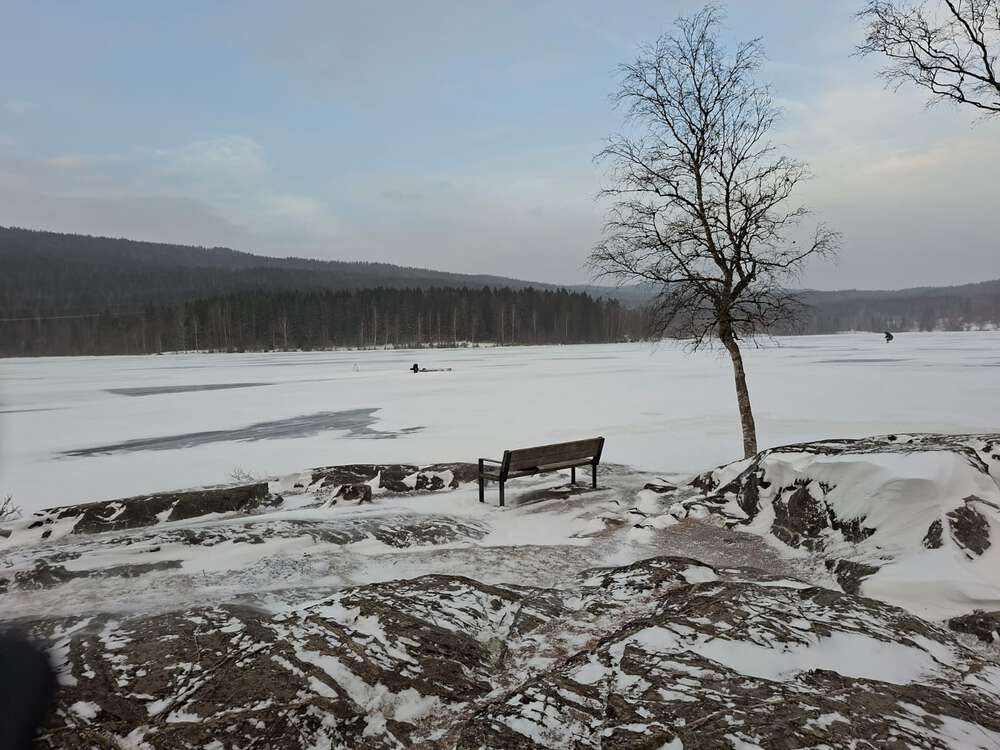
The class also went to Sognsvann together with Birgitte Fredriksen (student humanist in Oslo) who led a "nature conversation" with the group, discussing the variety of affects arising from climate change.
The course offered students not only new analytical perspectives on literature and ecology, but also used physical spaces for the students to reflect on their own emotional relationships with the natural world. By combining historical texts, contemporary literature, creative practice, and shared experiences in nature, the course demonstrated how deeply intertwined storytelling, environment, and human feeling are across cultures and time periods.