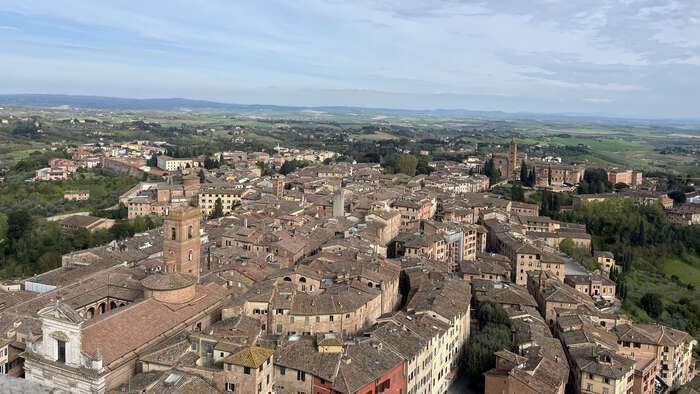
Emil Hanslien Gulbrandsen arrived in Rome in January 2025 to study history as part of his bachelor’s degree at the Department of Archaeology, Conservation, and History (IAKH) at the University of Oslo. He stayed on to continue studying Rome in Rome the following autumn and has spent much of this spring semester working on his BA thesis at the Norwegian Institute in Rome.
“Well, I have finally arrived in this great capital of the world … Now I am here at last, calm and at ease, and it seems I shall remain so for the rest of my life; for one might almost say that a new life begins when a man first sees with his own eyes all those things he has previously only heard or read about, and then only in part.”
Thus, the German writer Johann Wolfgang von Goethe described the Eternal City during his first stay here in the eighteenth century. It is no coincidence that Rome has so often been called “the capital of the world.” Since the fall of the Western Roman Empire in 476, the city has been a point of reference, a source of inspiration, and the stuff of myth for countless people. I too have had the chance to experience, sense, and wander among the very same places, ruins, and monuments that unnumbered pilgrims, intellectuals, and tourists have passed through before me. Thanks to the Norwegian Institute in Rome, inspiring teachers, and friendly fellow students, my one-and-a-half years in Rome have felt like a true intellectual journey.
From the birth of Rome to the centre of the papacy
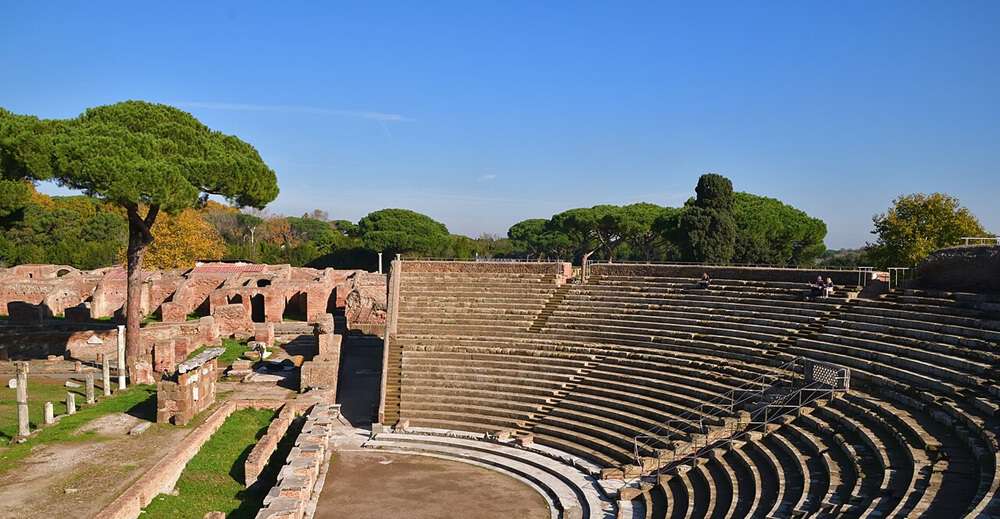
My journey began with three history courses in the spring of 2025. The first focused on antiquity, tracing Rome’s “birth” in the time of Romulus, its transformation from city-state to monumental imperial capital under the emperors, and the gradual reshaping of the city through the introduction of Christianity in Late Antiquity. Standing in front of Rome’s ancient monuments, you begin to see where what we call “modern Western civilization” has its roots. I learned that solutions we now take for granted – living in apartment buildings, for instance – were already partly developed by the Romans. The ruins of the insulae (tenement blocks) in Ostia, which we visited, bear witness to this.
At the same time, the Middle Ages are just as crucial for understanding our shared European heritage. In March, I took the course Rome as a Pilgrimage Destination in Medieval Europe and gained insight into how the pope gradually came to replace the emperor’s position. The Church slowly established a moral and spiritual hegemony over large parts of Europe – a development that helped turn Rome into a magnet for pilgrims. As we visited several of the city’s beautiful churches, I found myself reflecting on what it would have been like for someone from Gudbrandsdalen – I myself come from Vågå in the Gudbrandsdal valley – to set out on an exciting but dangerous journey across Europe in the Middle Ages in order to reach the tomb of Saint Peter.
Rome as a Myth
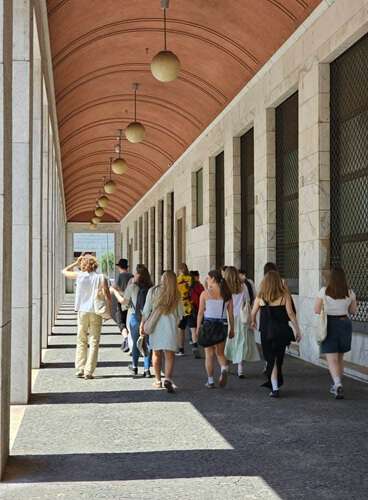
Photo: Elisabetta Cassina Wolff
The Eternal City has not only been a physical place shaped by economic and political forces; it has also served as a symbol for a wide range of actors, from the Church in the early Middle Ages to Mussolini and the Fascists in the interwar period. We learned more about this darker chapter of Rome’s history from Elisabetta Cassina Wolff, who taught the course The Myth of Rome in the Risorgimento and under Fascism. Through this course, I gained insight into how myths, symbols, and rituals from antiquity were revived to forge a new Fascist identity.
We strolled along the broad avenue stretching between the Colosseum and Piazza Venezia, the Via dei Fori Imperiali. There, we could picture Fascist soldiers marching with legs lifted high, and the Duce delivering his “fiery” speeches. Everything revolved around convincing the masses that Fascism was the true faith, that the state stood above the individual. The ruins of the imperial fora and the Roman Forum became a stage set for Fascist spectacles. It was fascinating to learn how the Roman legacy was mobilised in the vision of a Fascist world that was desired, but never fully realised.
After half a year in the city, I was well and truly “bitten by the Rome bug.” As I wrote in a poem during my stay: “The heart of the world has captivated the souls of many, with ruins and grandeur, love and sorrow.” That line sums up the strongest impression I was left with after six months of living and studying in the Eternal City. Here, the past is not something distant or tucked away behind glass; you feel as though you live side by side with it – and eventually become part of it yourself.
The Norwegian Institute in Rome serves as a bridge between Norwegian academia and the study of Rome’s historical, artistic, and cultural “layers.” This is made possible through, among other things, two courses that focus on Rome and the reception of Rome from antiquity to the present, both of which I had the pleasure of taking in the autumn of 2025. We went on excursions that took us from Romulus’ ancient hut to hyper-modern fast-food outlets like McDonald’s at Termini, the central train station. In this way, we really got to know Rome in all its guises – from the city of kings, senators, and emperors in antiquity, to the popes’ Rome in the Middle Ages and early modern period, and finally the modern Rome of Italian unification and our own time.
From Rome to the Desert Land of Turkmenistan and the “Heart of the Mediterranean”: Sardinia
One thing led to another. As a kind of climax to my Grand Tour, I was able to write my bachelor’s thesis at the Institute and, in addition, experience the “heart of the Mediterranean”: Sardinia.
After studying political religion and making countless trips to Rome’s modern EUR district – originally intended to become the “third Fascist Rome” – I found the inspiration for my thesis topic. I wanted to explore similar strategies of legitimation used by Mussolini and by the authoritarian president Niyazov in Turkmenistan. This mysterious yet fascinating desert country in Central Asia is largely unknown to us in the West. That made it all the more exciting to compare similar mechanisms in two very different historical and cultural contexts.

After completing my thesis, I had the opportunity to visit and learn more about the rich cultural heritage of southwestern Sardinia through a project focusing on mining in Sardinia and in Røros, organised by the Fondazione Giuseppe Dessì in collaboration with the Literary Parks. Together with a group of fellow students, I followed in the footsteps of the novelist Giuseppe Dessì in Villacidro – a mountain village that became a key reference point and source of inspiration for his most famous novel, Paese d’ombre (The Land of Shadows). Projects like this can deepen our understanding of two comparable cultural settings – in terms of local customs and knowledge, but also the universal features of mining communities at opposite ends of the European continent.
All in all, thanks to the Norwegian Institute in Rome, I have grown – personally and intellectually – through this wealth of impressions and experiences. Traditionally, “educational journeys” refer to the classic travels undertaken by European intellectuals during the Enlightenment. As as a native of the rural Gudbrandsdalen valley, it has been an enormous privilege to immerse myself in the humanities in this vibrant city of the past.

A presto, Roma!
Would you like to study in Rome? An overview of available courses can be found on out webpages. Students are always welcome - and consistently find it useful - to work on their thesis in the library at the Norwegian Institute in Rome.