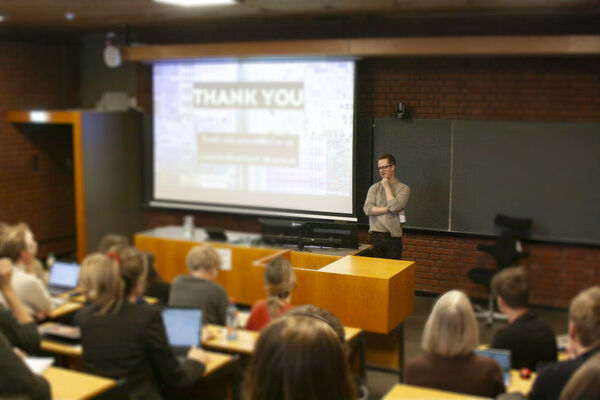
Nick Srnicek delivered an engaging presentation of his recent book, Silicon Empires: The Fight for the Future of AI (Polity, 2025), offering a deep dive into the geopolitical and economic perspectives shaping the implications of today’s rapid advances in AI. The session concluded with a lively Q&A on the evolving economic and geopolitical dimensions of generative artificial intelligence.
Srnicek, Senior Lecturer in Digital Economy at King’s College London, explored several possible trajectories for the future of contemporary AI. He outlined four concurrent strategies that leading tech conglomerates appear to be pursuing in order to capture value within a self-reinforcing economic ecosystem. He also mapped potential geopolitical configurations for the global AI landscape, pointing to scenarios ranging from digital sovereignty projects to collaborative initiatives among the United States, China, and European countries. These dynamics, he suggested, will shape whether states adopt primarily cooperative or competitive approaches to AI infrastructure and network architectures. A central question going forward is how states can best safeguard their interests while protecting regional actors and preserving strategic autonomy.
Srnicek further described the emergence of tightly interconnected AI clusters, driven by platform-centric conglomerates that control multiple layers of the AI stack—from data acquisition to model training and deployment. These clusters, he argued, intensify competition not only among corporations but also among nation-states, particularly between the United States and China. Among other issues, the audience discussed how the implications of corporate-driven AI expansion for research openness and democratic values might be framed and navigated in a rapidly evolving landscape of large language model development and its associated economic structures.
HumAIn Talks will continue to facilitate interdisciplinary dialogue on the societal impact of AI, fostering collaboration across the humanities, social sciences, and technical disciplines.
Sign up for our e-mail list, or follow us at LinkedIn or Facebook.