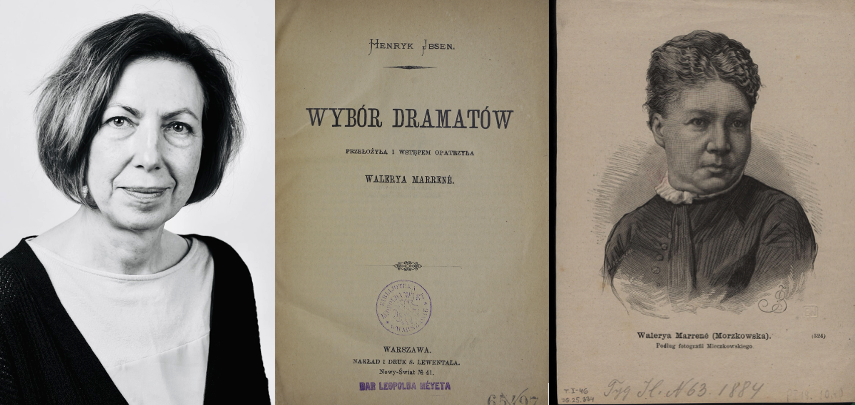
During the seminar, I will present the theoretical framework of my research project on Ibsen’s Munich trilogy and I will discuss two early Polish women’s interpretations of Hedda Gabler—by Waleria Marrené and Maria Rafałowiczówna—as active contributions to the play’s textual fluidity.
Central to my theoretical framework are the textual theories of Jerome McGann and John Bryant. I interpret these as relational approaches that underscore the primary role of networks and (cor)relations in the construction of meaning. Drawing upon McGann’s concept of the literary work as a historicized eventa nd Bryant’s understanding of the text as dynamic energy, while acknowledging the critical nuances between their stances, I will examine some extratextual aspects and the individual and social energies that structured the meanings of Hedda Gabler within Polish culture.
I am particularly interested in a distinct energy of women’s readings of Ibsen in Poland during the late nineteenth and early twentieth centuries as this dimension of reception remains largely unrecognized. From the perspective of fluid-text theory, translations and commentary can be considered as active manifestation of textual energy. They can be understood as cultural revisions designed to adapt and align Ibsen’s texts with the specific expectations and needs of readers—in this case, culturally situated female readers. Drawing on the frameworks of Bryant and McGann, I will trace the historical, social, and material specificities of Marrené’s and Rafałowiczówna’s interactions with the text of Hedda Gabler, examining whether it is possible to describe socially determined expectations and needs that motivated these processes.
Please note that this seminar will be streamed. To participate remotely, please register at this link no later than 4 November. A Zoom link will be sent on the day of the seminar. Please also remember that this seminar is primarily intended for participants on campus, and therefore not optimized for remote streaming.