This course is part of HF's PhD week.
Course content
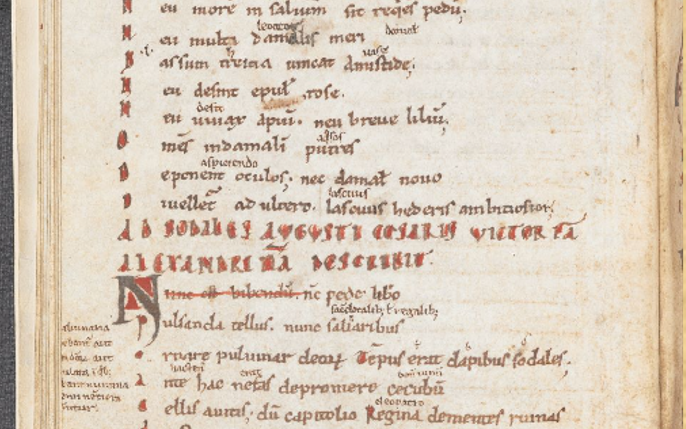
In our daily routine of reading and studying, literary works seems almost identical with the printed text in front of us. However, the latter is not an immediate representation of what authors like Homer or Virgil wrote, but rather a reconstruction, based on a varied manuscript tradition and a complex set of rules and theories applied by modern editors (mostly) in search of an archetype. The process which took them to their printed version of the text is documented in the part of our books we usually ignore: the editorial principles in the preface and the critical apparatus at the end of the page.
These explanations are mostly formulaic and must be deciphered but provide manifold information about the history of the texts and its transmission as well as about the cultures of reading and writing through which they travelled before they finally ended up on our desks. Here, the course steps in: it will offer a basic introduction in the scholarly conventions of textual criticism and editing (including an prospect on digital editions) and explore what they tell us about the literary culture at the times of their transmission (including that of their editors). The course will provide both theoretical and historical background knowledge as well as practical exercises.
This is a 1 ECTS course.
Course preparations
Course participants will read about 100 pages of mandatory readings and select at least 200 pages of your own choice from the lists of suggested readings or other relevant studies. Participants will write a brief (1 page) paper where you present and discuss one aspect of manuscript culture or editing. You will also write a 2-page presentation of a text-critical problem in a text you are working on in your field or research project. The two texts should be uploaded to the digital course site by mid-November.
Click here to see a list of the curriculum. Please see the course Canvas room for electronic access.
In class
In class the course organizers will give a presentation (2 x 45 minutes) presenting the basics of manuscript production and editing methods, with examples from ancient and medieval literature. The main part of the day will be devoted to discussions in groups and / or plenary based on your texts. We end with a plenary session relating text-critical questions to the larger context of ancient and medieval reading culture.
Language
The course language is English, including reading responses and essays. We will switch to Norwegian in class if everyone is able to follow what is being said.
Registration
Courses are open for PhD fellows, completion grant holders, and post-doctoral fellows at the Faculty of Humanities, other UiO faculties and external PhD fellows. Candidates admitted to the PhD programme at HF are given priority. Registration opens at noon on October 6.
Course instructors
- Senior lecturer Tor Ivar Østmoe, Department of Philosophy, Classics, History of Art and Ideas
- Dr. Bernhard Hollick, Department of Archaeology, Conservation and History