About the project
In various parts of East Asia, aquatic mammals are associated with divine power and serve as objects of devotion. Cetaceans are worshipped in south and central Vietnam as life-saving deities. The spirits of whales are venerated during ritual ceremonies in some Japanese coastal areas. Aquatic mammals have all been associated with water deities in China, Cambodia, Indonesia, and the Ryukyu Islands.
These animals continue to carry significant symbolic capital today – if no longer as gods, at least as local heritage and symbols of nature conservation, acquiring new meanings in the context of secularisation, (forced) displacement, and environmental degradation.
The project "Whales of Power: Aquatic Mammals, Devotional Practices, and Environmental Change in Maritime East Asia" is concerned with the comparative study of human-cetacean relations in maritime East Asia, as expressed in popular worship practices and beliefs. We examine several of these traditions in different parts of the region, through a combination of historical and ethnographic research.
Our main hypothesis is that changes in local worship traditions reflect changes in human-nature relations, caused by wider social, economic and environmental developments. Thus, marine mammals and associated worship practices serve as a prism, through which we approach human responses to socio-economic and environmental change in Asian coastal communities.
Objectives
Whales of Power combines state-of-the-art theoretical approaches from different disciplinary traditions in order to reach new understandings of the ways in which human-nature-god relations reflect social and environmental changes. The project has three core theoretical objectives:
- Apply recent theoretical developments associated with environmental humanities to the comparative study of popular religion.
- Reconsider the role of local worship traditions in the Asian Secular Age, examining the new meanings attributed to ritual practices.
- Contribute to the establishment a new comparative paradigm in Asian studies.
Sub-projects
Whales of Power is divided into the following work packages, each of which takes up one or several case studies:
- Work Package 1: Whale Worship and Environmental Change in Japan and Vietnam: A Comparison (PI, Aike P. Rots)
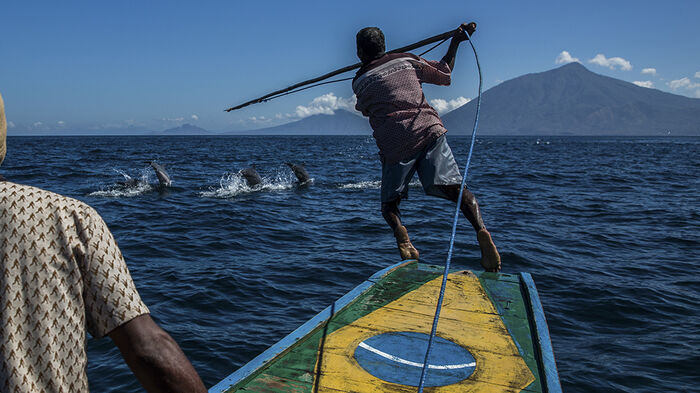
- Work Package 2: Traditional Whaling, Ritual Change, and Nature Cosmology in Eastern Indonesia (Postdoc, Florence Durney)
- Work Package 3: Divine Dugong? Sacralisation and Environmental Activism in Okinawa (PhD, Marius Palz)
- Work Package 4: The Whale God in Contemporary Vietnam: Urbanisation, Tourism, and the Heritagisation of a Popular Worship Tradition (PhD, Anh Tuan Nguyen)
- Work Package 5: “In Harmony with Nature”: Whaling, Eco-Spirituality, and the Politics of Indigeneity (PhD, Sonja Åman)